
We may earn money or products from the companies mentioned in this post.
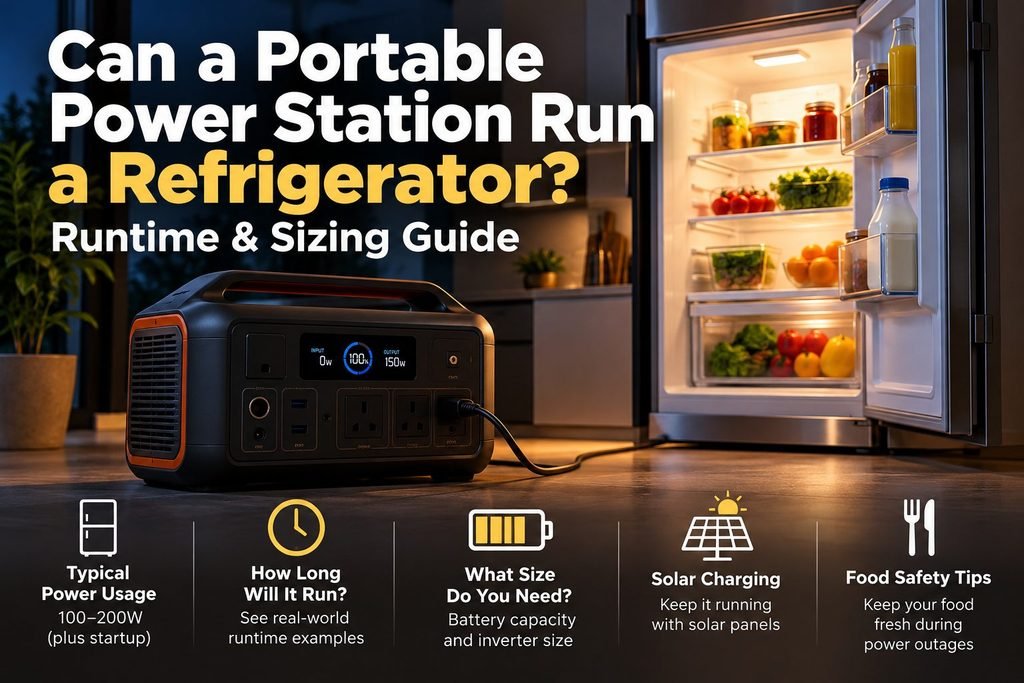
Quick answer: Yes, many portable power stations can run a refrigerator during a power outage. The key is choosing a model with enough continuous AC output to run the compressor, enough surge capacity to start it, and enough usable battery energy for the hours you need.
Before buying, check your refrigerator’s label or manual, and measure actual consumption with a plug-in energy meter where possible. The examples below are estimates, not promises of runtime.
Can a portable power station run a refrigerator?
Most modern portable power stations with an AC inverter can power at least some refrigerators. But “can it run?” and “how long will it run?” are two separate questions. A fridge compressor briefly draws more power at startup than it uses while running. It also cycles on and off throughout the day, so multiplying its running watts by 24 hours can overestimate energy use.
Three numbers to check before buying
1. Running watts
Find the refrigerator’s rated input power, or measure it while the compressor is running. Your power station’s continuous AC output should comfortably exceed this figure, with room for any other appliances.
2. Compressor startup surge
Refrigerators can demand a short burst of power when their compressors start. Look at the power station’s surge specification, but remember that manufacturers may define surge ratings differently. A model with sufficient running watts can still trip if it cannot handle startup.
3. Energy consumption in watt-hours
Battery capacity is expressed in watt-hours (Wh). A 1,000 Wh battery does not normally deliver a full 1,000 Wh to an AC appliance because the inverter and electronics consume energy too. The fridge’s daily energy consumption, rather than its peak wattage, is usually the best starting point for runtime.
Portable power station refrigerator runtime examples
For illustration, assume 85% usable AC energy from the battery after conversion losses. Actual efficiency depends on the model, load, temperature and operating conditions.
| Battery capacity | Usable AC energy (estimate) | At 500 Wh/day | At 1,000 Wh/day |
|---|---|---|---|
| 500 Wh | 425 Wh | About 20 hours | About 10 hours |
| 1,000 Wh | 850 Wh | About 41 hours | About 20 hours |
| 2,000 Wh | 1,700 Wh | About 82 hours | About 41 hours |
Illustrative calculations only. Figures assume a refrigerator averaging 500 or 1,000 Wh per 24 hours, no other connected loads, and a full battery at the start. Actual results can vary substantially.
How to calculate your own refrigerator runtime
Use this simple formula:
Estimated runtime (hours) = battery Wh × usable-energy factor ÷ refrigerator’s average watts.
If the refrigerator’s energy label shows consumption in kWh per year, estimate its daily energy use by multiplying by 1,000 and dividing by 365. Then divide the power station’s estimated usable Wh by that daily Wh figure and multiply by 24 to get approximate hours. Real-world use may differ from energy-label test conditions.
Example: A refrigerator rated at 250 kWh/year uses about 685 Wh/day on the label. A 1,000 Wh power station with 85% usable AC energy would provide approximately 850 ÷ 685 × 24 = 30 hours, assuming the inverter can start the compressor and no other loads are attached.
Want help estimating the load from several appliances? Try our free portable power station calculator.
What size power station should you choose?
If you are wondering, can a portable power station run a refrigerator overnight, the answer depends on both your fridge’s daily energy consumption and the power station’s usable battery capacity.
For a short outage, a roughly 1,000 Wh unit may be useful for an efficient refrigerator, provided it handles compressor startup. For longer outages, larger or expandable batteries offer more breathing room. A freezer, older refrigerator, hot room or frequent door opening can increase demand.
Check each model’s continuous AC output, surge behaviour, battery capacity, expansion options and whether it supports pass-through charging. Avoid relying solely on marketing claims such as “runs a fridge for two days.”
Will solar panels keep a refrigerator running?
Solar charging can extend runtime, but panel ratings represent ideal conditions. Weather, shade, season, charging limits and available daylight all affect how much energy reaches the battery. The system still needs enough stored energy to power the refrigerator overnight and during cloudy periods. See our guide to charging a portable power station with solar panels.
Food safety during an outage
Keep refrigerator and freezer doors closed as much as possible. The US government’s FoodSafety.gov power-outage guidance explains how long food may remain safe without power and when to discard it. A power station is helpful, but it is not a substitute for monitoring food temperature.
Frequently asked questions
Can a 500 W power station run a fridge?
Possibly, but not always. A 500 W continuous-output inverter might cover the fridge’s running draw yet fail on compressor startup. Verify the appliance’s requirements and the power station’s documented surge capability.
Does a refrigerator use electricity constantly?
Most compressor refrigerators cycle on and off. Some models also use energy for fans, controls and defrost cycles. Measuring energy use over a full day is more informative than a single instant wattage reading.
Can I use a portable power station indoors?
Battery-powered stations are generally designed for indoor use according to their manuals, with suitable ventilation and environmental conditions. Never operate a fuel-burning generator indoors or near openings because of carbon monoxide risk.
Should I power my entire kitchen from one unit?
Usually not without careful load planning. High-power appliances such as kettles, microwaves and toasters can exceed the inverter’s continuous output or drain the battery quickly.
Bottom line
Choose a power station based on refrigerator startup power, daily energy use and desired backup duration—not battery capacity alone. If you’re comparing options, start with our portable power glossary, browse the portable power station FAQs, or use the calculator to estimate your needs.