
We may earn money or products from the companies mentioned in this post.
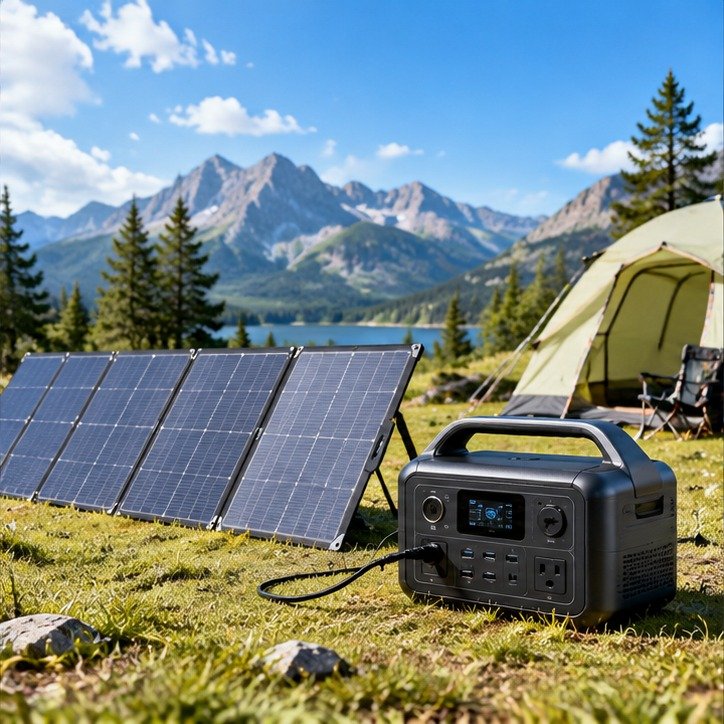
If you want to charge a portable power station with solar panels, start by checking your equipment’s compatibility. Charging a portable power station with solar panels can keep lights, phones, laptops and a camping fridge running when mains power is unavailable. The key is matching the panel’s electrical output to the power station’s solar input—not simply buying the largest panel you can find. This guide explains the essentials, including connectors, voltage limits and realistic charging expectations.
How to charge a portable power station with solar panels safely
Find the manufacturer’s input specifications for the exact model and region. Look for the permitted voltage range, maximum input current, maximum solar wattage and connector type. All four matter. A panel combination that exceeds the permitted open-circuit voltage can damage equipment, even if its advertised wattage looks suitable.
Understand watts, volts and amps
Panel power is approximately voltage multiplied by current (W = V × A) at its operating point. The panel label usually lists maximum-power voltage (Vmp), maximum-power current (Imp) and open-circuit voltage (Voc). The station’s solar controller needs a compatible operating voltage, and the total array Voc must stay within the manufacturer’s specified limit, including an allowance for colder weather when voltage can rise.
Can you use any solar panel?
Not automatically. Many power stations accept third-party panels, but connectors, polarity and electrical ratings vary. Common connections include MC4 on solar panels and proprietary or DC inputs on power stations. Use a cable or adapter explicitly approved for your equipment; never assume two plugs with the same shape have the same polarity.
How long does solar charging take?
A rough starting calculation is battery watt-hours divided by actual charging watts. For example, replenishing 800Wh at a steady 160W would take at least five hours before charging losses and tapering are considered. In practice, solar input fluctuates throughout the day, so the actual time can be substantially longer.
| Illustrative average solar input | Energy captured over 4 hours* |
|---|---|
| 50W | 200Wh |
| 100W | 400Wh |
| 150W | 600Wh |
| 200W | 800Wh |
*Simplified input-energy examples, not energy stored in the battery. Real charging includes losses and may slow as the battery approaches full. The panel’s rated wattage is not the same as its average delivered wattage.
Series vs parallel panels
Connecting panels in series raises voltage while current stays roughly the same. Connecting matching panels in parallel raises current while voltage stays roughly the same. Neither arrangement is universally better: the correct choice depends on the power station’s allowed voltage and current. If the manufacturer does not document multi-panel configurations for your model, do not improvise wiring.
How to improve solar charging at camp
- Put panels in direct sunlight, clear of branches, tents and vehicle shadows.
- Aim panels toward the sun and adjust their angle during the day.
- Keep connectors dry, undamaged and firmly attached according to the manufacturer.
- Keep the power station within its permitted operating temperature range and out of direct heat where possible.
- Use the station’s display or app to check actual incoming watts rather than relying on panel marketing claims.
What size panel should you buy?
To charge a portable power station with solar panels effectively, start with your daily energy use. If you need 400Wh per day and can reasonably expect four effective charging hours, you need about 100W of average charging input before accounting for losses. That could require a panel with a significantly higher nameplate rating, depending on local weather and setup. More panel capacity helps only until you reach the station’s solar input limit.
For general guidance on solar technology and performance, consult the US Department of Energy’s solar energy basics.
Common mistakes to avoid
- Exceeding the power station’s maximum input voltage.
- Using an adapter with incorrect polarity or an unsupported connector.
- Assuming a 200W panel delivers 200W continuously.
- Placing part of the panel in shade and expecting full output.
- Relying on a single sunny-day estimate for a multi-day trip.
Which portable power station works well with solar?
Solar compatibility should be considered alongside weight, battery capacity and inverter output. Our Jackery Explorer 1000 v2 vs EcoFlow DELTA 2 comparison discusses the two models’ different rated solar inputs. Before purchasing, check current manufacturer manuals for your exact regional model.
Bottom line: choose a compatible panel configuration, respect voltage and current limits, and plan around realistic sunlight rather than the advertised peak wattage.