
We may earn money or products from the companies mentioned in this post.
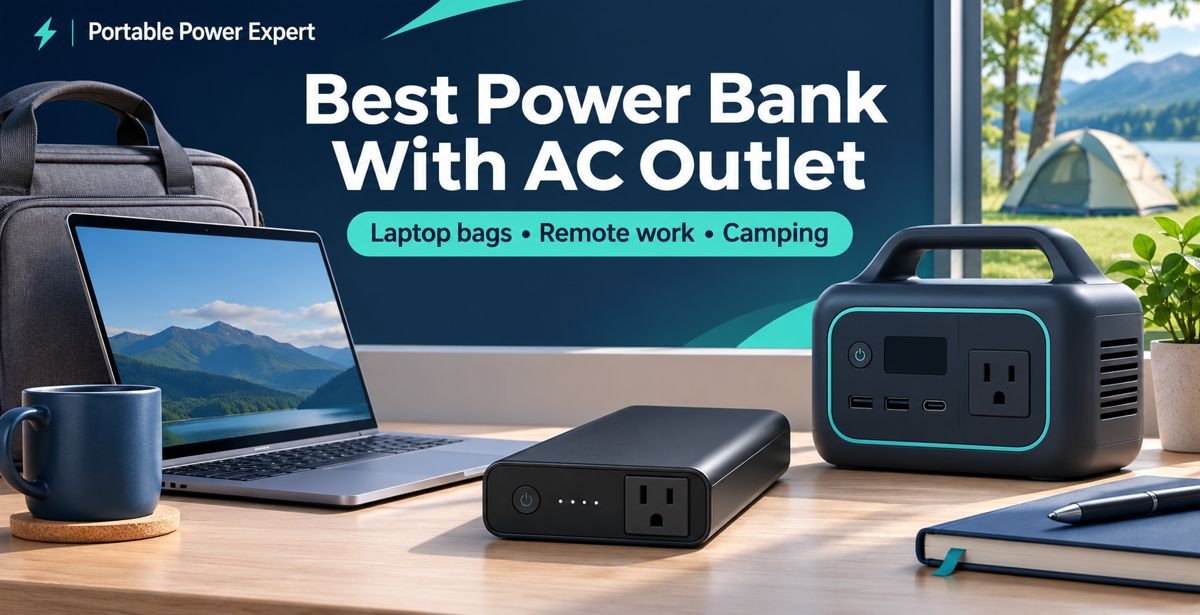
The best power bank with AC outlet depends on one question: do you need something that slips into a laptop bag, or enough stored energy for several hours away from a wall socket? Our compact pick is the Omnicharge Omni 20+. For longer sessions, compare the EcoFlow RIVER 3 and BLUETTI Elite 30 V2, which are small portable power stations.
Editorial disclosure: This is a comparison of published manufacturer specifications, not a hands-on test. Some links are affiliate links; we may earn a commission at no extra cost to you. Recommendations reflect suitability for the uses below. Specifications checked November 8, 2026; confirm the exact regional model before ordering.
Best power bank with AC outlet: quick comparison
| Model | Best fit | Battery | Rated AC output | Weight |
|---|---|---|---|---|
| Omnicharge Omni 20+ | Laptop bag and occasional AC charging | 71Wh | 100W; modified sine wave | 1.35lb / 611g |
| EcoFlow RIVER 3 | Portable desk setup and light camping | 245Wh | 300W total | 7.8lb |
| BLUETTI Elite 30 V2 | Higher AC output in a small power station | 288Wh | 600W total; pure sine wave | 9.48lb / 4.3kg |
Our buying advice: choose the Omni for minimum bulk. Choose a power station when runtime matters more than fitting everything into your everyday bag. If your laptop charges by USB-C, check whether a USB-C power bank could meet your needs more simply.
1. Omnicharge Omni 20+: best compact AC power bank
The Omni 20+ is our pick when the purpose is carrying an AC outlet in a laptop bag. Its 71Wh battery and 100W AC output prioritize portability. It also offers up to 60W USB-C output.
Main advantage: at 611g, it is much easier to carry daily than the power stations below. Main limitation: the AC outlet uses a modified sine wave. Check your equipment manufacturer’s compatibility requirements; do not assume every device suitable for a home socket will work well with it.
Choose it for occasional charging of compatible electronics within its output rating. The small battery makes it a poor fit for sustained appliance use.
Check Best Price — Omnicharge Omni 20+
2. EcoFlow RIVER 3: a small power station for longer sessions
The standard 245Wh RIVER 3 provides 300W rated AC output and up to 100W USB-C output. At 7.8lb, it is a carry-along power station rather than a slim power bank.
Main advantage: its larger battery makes it a more practical starting point for longer laptop sessions or several small devices. Main limitation: 300W is a shared AC limit, so add up simultaneous loads.
EcoFlow advertises X-Boost up to 600W for compatible equipment. Treat 300W as the normal rated output when comparing models. Check the exact version: this recommendation refers to the 245Wh RIVER 3, rather than a similarly named variant.
Check Best Price — EcoFlow RIVER 3 options — the linked manufacturer listing includes a solar-panel bundle; compare the configuration before ordering.
3. BLUETTI Elite 30 V2: best higher-output alternative here
The Elite 30 V2 combines a 288Wh battery with 600W total pure sine wave AC output. Its USB-C connections include up to 140W and 100W outputs, and it weighs 9.48lb.
Main advantage: more AC output headroom than the other two picks. Main limitation: it is the heaviest option here, and 288Wh still limits sustained runtime.
Choose it when your compatible equipment exceeds the smaller models’ normal AC ratings. Its advertised 1,500W Power Lifting figure is not equivalent to a 1,500W continuous inverter rating.
Check Best Price — BLUETTI Elite 30 V2
Read our BLUETTI Elite 30 V2 review for more detail.
How to choose the best power bank with AC outlet
Start with watts, then watt-hours
Watts describe how much power equipment needs at a moment in time. Watt-hours describe stored energy. A battery may have enough energy for a task but lack the output to start the equipment. Conversely, a high-output inverter can drain a small battery quickly.
Check the charger’s input rating and, where practical, measure actual consumption with a plug-in energy meter. Leave output headroom and include every device you plan to connect. Motors and compressors can require additional starting power.
Check whether you need AC at all
An AC setup converts battery energy into AC electricity, then a laptop charger converts it again. Direct USB-C charging can avoid that conversion path. Check the laptop’s required USB Power Delivery profiles, charging wattage and cable rating; a USB-C connector alone does not guarantee compatibility.
Check the waveform and regional version
Confirm the required waveform with your equipment supplier. Also check outlet shape, output voltage and frequency. A plug adapter changes the physical connection; it does not automatically change the electrical output.
Think about the return journey
A portable battery is only useful again once it is recharged. Consider where you can charge it, whether a suitable charger is included, and how much time you will have. For outdoor trips, read our camping battery sizing guide.
How long will an AC power bank last?
Use this planning formula: runtime in hours = usable energy in Wh ÷ average load in W. Battery-label capacity is not the same as energy delivered through an AC outlet.
For illustration only, assume a 250Wh battery delivers 80% of its nominal capacity after conversion losses: 200Wh. At a steady 50W load, that gives approximately four hours. At 100W, approximately two hours. These are calculated examples, not measured results for the products above.
Inverter overhead, battery condition, temperature, settings and changing device demand affect results. Very small AC loads can have proportionally high losses. A charger marked 100W also does not necessarily consume 100W continuously.
Use our portable power calculator to plan your device list and required runtime.
Frequently asked questions
Can an AC power bank run a gaming laptop?
Only if its output and the laptop’s charger requirements are compatible. Demanding workloads can require considerably more power than light browsing. Check the original charger and expected load before choosing.
Can I run a heater or kettle?
Do not assume so. Check the appliance’s wattage against normal continuous output and follow the battery manufacturer’s instructions. Sustained heating also consumes stored energy quickly.
Is a larger battery always better?
Extra capacity can extend runtime but usually adds bulk. For commuting, a small compatible unit may be easier to carry. For a remote desk or camping trip, the extra energy may justify a power station.
Which should I buy?
Choose the Omni 20+ for a compact laptop-bag AC option after checking waveform compatibility. Compare the RIVER 3 for longer light-device sessions, or the Elite 30 V2 when you need more rated AC output. Match the battery to your devices before comparing today’s offers.
Check Best Price — BLUETTI Elite 30 V2