
We may earn money or products from the companies mentioned in this post.
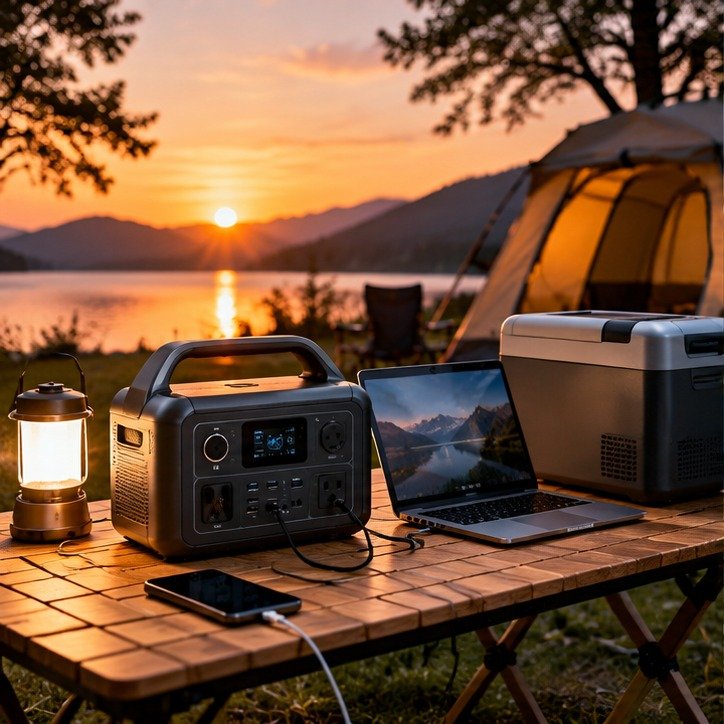
Wondering what size portable power station for camping you need? Choosing a portable power station for camping starts with two questions: how much energy will your devices use, and how much power must the station deliver at one time? A small battery can comfortably charge phones and lights, while an electric kettle may demand more power than many compact stations can supply. This guide shows you how to size a camping power station without paying for capacity you will not use.
Watts vs watt-hours: the difference that matters
Watts (W) describe the power an appliance draws at a given moment. Watt-hours (Wh) describe stored energy. A 60W device running continuously for five hours uses 300Wh (60 × 5). A station rated at 1,000Wh does not necessarily deliver all 1,000Wh to AC appliances: conversion losses, standby consumption, temperature and battery protection reduce usable energy.
What size portable power station for camping? Make a power budget
List every device, its approximate power draw and the number of hours it will operate per day. Multiply watts by hours for each device, then add the results. Use actual labels or a plug-in energy meter where possible, rather than relying on generic estimates.
| Example device | Assumed power and time | Daily energy |
|---|---|---|
| LED campsite lights | 10W × 5 hours | 50Wh |
| Laptop charging | 60W × 2 hours | 120Wh |
| Phone charging | 15Wh per full charge × 2 | 30Wh |
| Portable fridge | 40W average × 8 equivalent hours | 320Wh |
| Total | 520Wh |
These figures are examples, not measurements. A compressor fridge switches on and off, so its average daily energy use depends heavily on weather, thermostat settings and insulation. A laptop’s charging power also changes during use.
Allow for energy losses and a safety margin
When deciding what size portable power station for camping to buy, start with a quick first estimate: divide the calculated daily energy use by 0.8 to allow roughly 20% for losses and reserve. In the example above, 520Wh ÷ 0.8 = 650Wh of nominal capacity for one day. For two days without recharging, that becomes roughly 1,300Wh. The 80% assumption is only a planning shortcut; actual usable capacity varies by product and whether you use AC, USB or DC outputs.
How much power output do you need?
Battery size alone is not enough. Add up the watts of devices you plan to operate simultaneously and choose a power station with a continuous output rating above that total. Motors, pumps and some refrigerators can briefly draw more at startup, so check surge requirements as well. A 1,000Wh station with a 500W inverter will not run a 1,200W appliance just because the battery has plenty of energy.
Practical capacity ranges for different trips
- Under 300Wh: short trips mainly charging phones, cameras, lights and small USB devices.
- 300–700Wh: weekend basics, some laptop use and modest DC loads, depending on charging access.
- 700–1,500Wh: more comfortable car camping with multiple devices or a fridge, subject to actual daily energy use.
- Above 1,500Wh: longer off-grid stays, larger appliances or multiple people; consider weight and recharging time.
These are broad planning ranges, not guarantees. A high-wattage heater can empty even a large station quickly, making gas or another suitable camping heating solution more practical where safe and permitted.
What about solar charging?
A solar panel can reduce the amount of battery capacity you need if sunlight is reliable. But a panel labelled 200W will rarely deliver 200W for every hour of daylight. Weather, panel angle, shade and charge-controller limits all matter. Plan for a low-sun day rather than assuming perfect conditions.
Example: choosing between two 1kWh models
If your calculations point toward a roughly 1kWh station, our Jackery Explorer 1000 v2 vs EcoFlow DELTA 2 comparison explains the trade-offs between weight, AC output and expansion. You can also read the Jackery Explorer 1000 v2 review for a closer look at one option.
For further guidance on calculating electrical loads, see the US Department of Energy’s appliance energy-use guide. It explains how wattage and operating time affect electricity consumption.
Quick sizing checklist
- Calculate daily watt-hours for each device.
- Multiply by the number of days without charging.
- Allow for conversion losses and a reasonable reserve.
- Check continuous AC output and appliance startup surge.
- Check weight, charging inputs, socket types and your budget.
The best camping power station is not necessarily the one with the largest battery. It is the one that safely powers your actual equipment for the duration of your trip.