
We may earn money or products from the companies mentioned in this post.
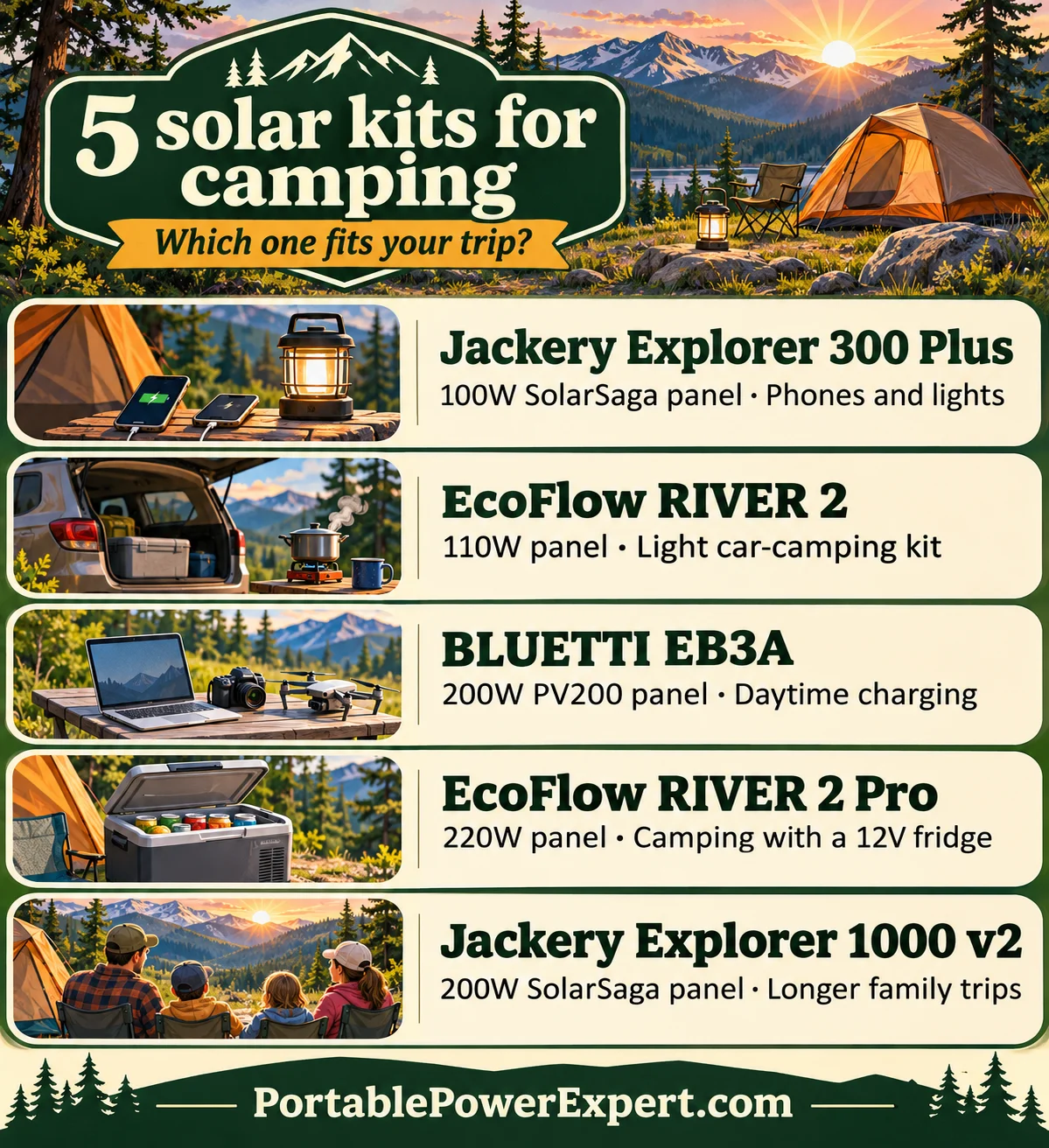
The best solar generator for camping depends on what you plug in after sunset. A phone and lantern need much less stored energy than a 12V fridge running through the night. Compare the kits below, then use the fridge example to estimate your own daily power use.
In this guide
Quick comparison
| Kit | Best use | Battery (Wh) | Panel (W) | Approx. Carry weight | Typical US bundle price* |
|---|---|---|---|---|---|
| Jackery Explorer 300 Plus + SolarSaga 100W | Phones and lights on a budget | 288 | 100 | ~16 lb | $450 to $600 |
| EcoFlow River 2 + 110W panel | Light, fast-charging small kit | 256 | 110 | ~16 lb | $400 to $550 |
| Bluetti EB3A + PV200 | Strong recharging on a small battery | 268 | 200 | ~28 lb | $550 to $700 |
| EcoFlow River 2 Pro + 220W panel | 12V fridge over a weekend | 768 | 220 | ~35 lb | $900 to $1,200 |
| Jackery Explorer 1000 v2 + 200W | Longer trips and bigger gear | 1,070 | 200 | ~40 lb | $1,000 to $1,400 |
Weights and prices are approximate and unverified. Confirm the exact bundle before you buy.
Transparency note: I did not hands-on test any of these kits. Specs come from manufacturer-published figures as I know them.
I could not run a live price check while writing, so prices are typical US ranges.
Bundles change often, so confirm the contents, panel wattage and price on the seller’s page.
Introduction
It’s so frustrating when you plug a fridge into your power station at dusk and find the battery flat by breakfast. However, if you add up your daily watt hours before you shop and match them to a panel that can refill them, you’ll wake up on day two with a battery that climbs back toward full by mid-afternoon and a fridge that never skips a beat.
Panels deliver roughly 70% of their rated watts, so you can plan your power with confidence.
If I were to estimate your daily camping power use, I’d say about 500Wh, that assumes a compressor fridge, two phones and two lanterns. Hot weather, an older fridge or a lid that opens every ten minutes can push that number well above 500Wh, and a laptop or fan adds more.
You have probably noticed that the battery size gets all the attention on a product page. Capacity is easy to print in large type on a box.
That’s why plenty of campers buy a big battery with a small panel and run short on the second night.
Even a 1,070Wh battery needs a day and a half of good sun to refill from empty with a 200W panel.
Give the panel as much of your attention as the battery. A modest battery with a strong panel can keep a daytime power user going for a week.
Plan to run your heavier gear while the sun is up so the panel feeds it directly.
It can be more difficult for you if you camp under tree cover, because shade can cut panel output by half or more. But a long extension cable let’s you keep the power station in the shade at camp and set the panel in a sunny clearing.
The 5 kits
1. Jackery Explorer 300 Plus + SolarSaga 100W
Reason to buy: Charging phones and lights on a budget.
The 300 Plus holds 288Wh in a compact body, and the 100W panel can refill most of that in roughly one good day of sun. It suits weekend campers with phones, a camera, a headlamp and a lantern.
Those loads can run for two or three days between charges.
Main drawback: The battery is small. A 12V fridge uses around 360Wh a day in the worked example below, so this kit empties in less than a day with a fridge attached. Check the spec sheet for the maximum solar input, since a small unit may limit how much a bigger panel can add.
2. EcoFlow River 2 + 110W panel
Reason to buy: A lightweight kit that charges quickly.
The River 2 holds 256Wh and uses a LiFePO4 battery, a chemistry known for long cycle life. EcoFlow lists a fast wall recharge, which helps when you top up at home the night before a trip.
It suits car campers who want the lightest kit that still covers phones, lights and a small fan.
Main drawback: Capacity sits close to the Jackery, which is too small for an overnight fridge plus everything else.
Compare RIVER 2 models at EcoFlow US
Prefer a flexible panel? EcoFlow also sells its 100W flexible solar panel separately.
3. Bluetti EB3A + PV200 (200W)
Reason to buy: Plenty of solar on a small battery.
The EB3A holds 268Wh, and the 200W panel can refill it in a single sunny afternoon with spare watts left over to run gear while it charges. That suits anyone who stays at one site for several days and uses power during daylight hours.
Main drawback: The 200W panel is large and heavy, which pushes the carry weight to roughly 28 lb. The battery is also small for fridge duty. Confirm the bundle includes the right cable to connect the panel.
For a compact setup to charge phones and run camp lights, the BLUETTI Elite 30 V2 has a 288Wh battery. BLUETTI offers a 100W solar panel bundle on the same product page.
If you want more battery capacity than the EB3A offers, the BLUETTI AC180 power station is an alternative you can pair with one PV200 panel.
Already have a power station? View the standalone BLUETTI 200W solar panel. The power station is sold separately.
4. EcoFlow River 2 Pro + 220W panel
Reason to buy: Running a 12V fridge over a weekend.
At 768Wh, with roughly 85% usable, the River 2 Pro holds about 650Wh. That covers the worked example below for around a day and a quarter without sun.
A 220W panel can return a full day of energy by evening in good weather.
It suits car campers with a compressor fridge, a few lights and device charging.
Main drawback: Carry weight. The combined kit is a two-trip haul from the car.
View the RIVER 2 Pro at EcoFlow US. Select the 220W panel option for this camping kit.
5. Jackery Explorer 1000 v2 + 200W SolarSaga
Reason to buy: Longer trips and bigger gear.
With about 1,070Wh, this kit can run a fridge, lights and phones for close to two days and still hold reserve charge. It suits families, week-long trips and anyone who adds a laptop or a small electric cooler.
Main drawback: Price and weight. A 200W panel takes about a day and a half to two days to refill a deeply drained battery, so the panel is modest next to the battery.
Worked example: 12V fridge, two phones and campsite lights
Here is a typical camping day. These figures are estimates, and your fridge, weather and habits will change them.
| Device | Assumption | Daily Wh |
|---|---|---|
| 12V compressor fridge | ~45W while running, about 33% of the time, over 24 hours (about 15W average) | 360 |
| Two phones | ~15Wh battery each, two full charges each | 60 |
| Campsite lights | Two LED lanterns, 5W each, 4 hours | 40 |
| Subtotal | 460 | |
| Conversion losses | ~8% added for DC conversion and cables | ~500 |
Overnight check. From 6pm to 8am is 14 hours. The fridge uses about 210Wh, the lights 40Wh and the phones about 60Wh, so you need around 310Wh.
Usable capacity is typically 85% to 90% of the label, which gives a 256Wh to 288Wh battery roughly 220Wh to 250Wh.
That falls short of 310Wh. A 768Wh or 1,070Wh battery covers the night with plenty left over.
Panel check. The assumptions are 5 peak sun hours (4 if it is hazy or shaded) and 70% real output after angle, heat and charge controller losses. Charging loss into the battery sits inside that 70%.
| Panel | 5 sun hours | 4 sun hours | Share of the 500Wh day |
|---|---|---|---|
| 100W | ~350Wh | ~280Wh | 56% to 70% |
| 200W | ~700Wh | ~560Wh | 112% to 140% |
A 100W panel replaces roughly two-thirds of this day, so you drift down about 150Wh daily. A 288Wh battery sustains that for a day or two.
A 200W panel covers the whole day on a sunny afternoon, and a 220W panel adds a little margin on a cloudy one.
Tips that help: Pre-chill the fridge at home on mains power. Keep the fridge in shade with the lid closed. Tilt the panel toward the sun and move it every couple of hours.
Run the fridge from the 12V port if your unit has one, which avoids inverter losses.
Which solar generator for camping fits your trip?
For phones and lights only, the Jackery 300 Plus bundle gives you the best value. The Bluetti EB3A makes sense if you want faster daytime recharging and can carry the extra weight.
For a 12V fridge, my pick is the EcoFlow River 2 Pro with the 220W panel. The battery covers the night in the example above and the panel returns the day’s energy.
If you travel for longer or add heavier gear, the Jackery 1000 v2 with 200W gives you the most buffer.
Before you spend money, put your own gear into the portable power station calculator to size a kit for your trips.
Once you have your daily Wh figure, check the exact bundle listing for your chosen kit and confirm the panel wattage and price before you order.
Frequently asked questions
Can a 100W panel run a 12V fridge?
It covers part of the load. A 100W panel gives roughly 280 to 350Wh in good sun, and a fridge in warm weather can use 300 to 500Wh a day alone.
Pair it with a large battery for a short trip, or choose a 200W panel.
Does the panel rating match what I will get?
Expect around 60% to 75% of the rating at midday in clear sun, and less in clouds, heat or low sun angles.
Can I charge while I use the gear?
Most units allow it, which is called pass-through charging. Daytime use comes straight from the panel, which saves battery cycles.
How long does recharging from empty take?
A 288Wh battery with a 100W panel takes about one sunny day. A 1,070Wh battery with a 200W panel takes about a day and a half to two days.
Can I add a second panel?
Often, within the unit’s maximum solar input in watts and volts. Check the spec sheet before buying a second panel.
Does cold weather affect charging?
Many lithium batteries limit or pause charging near or below freezing (32°F). Check the manufacturer’s low-temperature specs, and keep the power station in a sleeping bag or insulated bag overnight in cold weather.
What if it rains for two days?
Plan a reserve. Carry a 12V car charger cable or charge from the car while driving, and keep your battery above 30% when the forecast is poor.
References
– Jackery product pages: https://www.jackery.com
– EcoFlow product pages: https://www.ecoflow.com
– Bluetti product pages: https://www.bluettipower.com
– Portable Power Expert: https://www.portablepowerexperts.com
Specs are manufacturer-published figures as I know them. Prices are typical ranges and need confirmation on the seller’s page.
Pingback: Best Portable Solar Panels for Camping: 3 Foldable Picks