
We may earn money or products from the companies mentioned in this post.
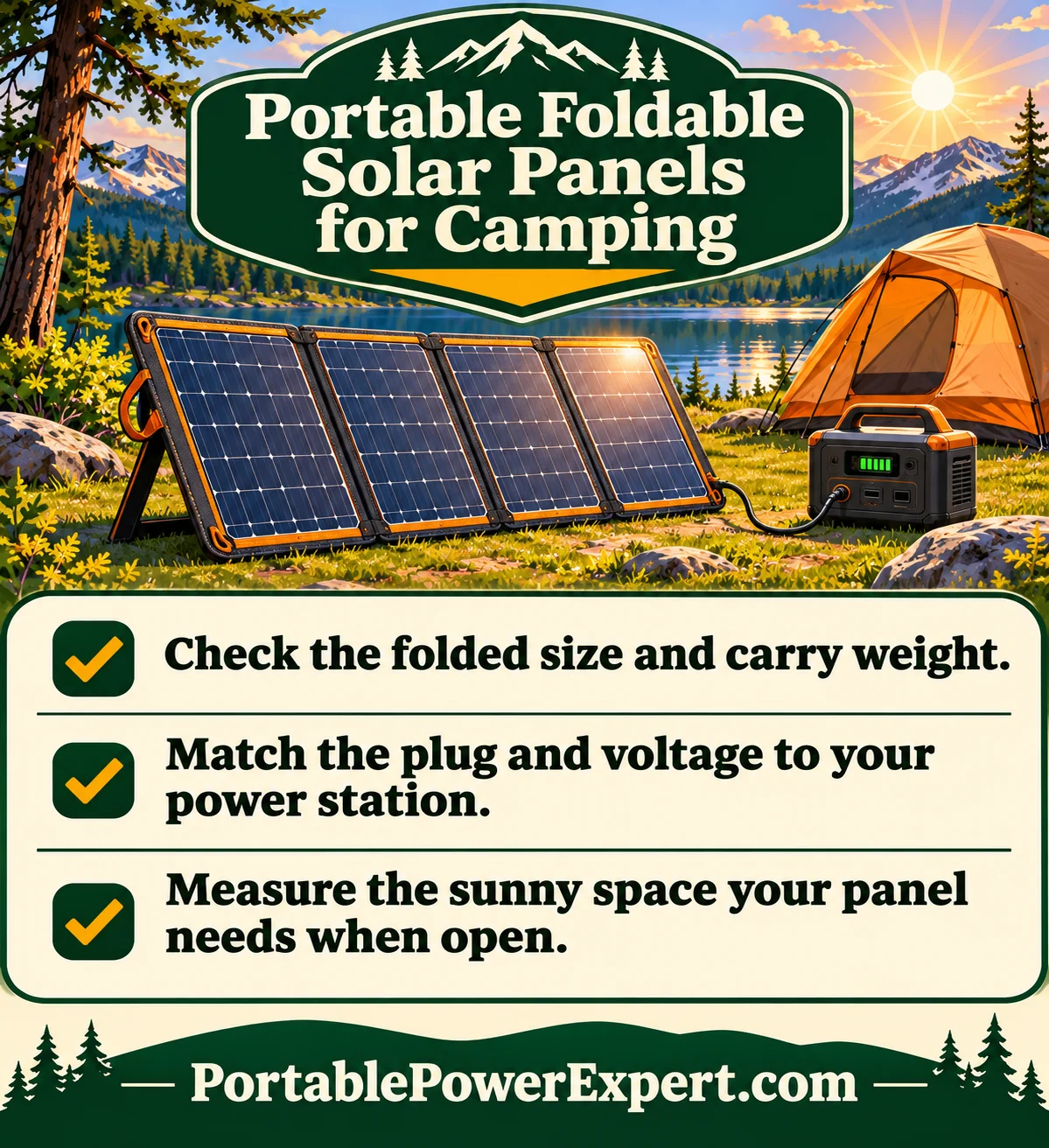
The best portable solar panels for camping depend on what you need to charge and how far you’ll carry the panel. For a walk-in campsite and a USB power bank, our pick is the Goal Zero Nomad 20. For a weekend with a small power station, we’d choose the Jackery SolarSaga 100W Air. For several nights with a powered cooler, the EcoFlow NextGen 220W is worth the extra trunk space if your station can use its output.
This guide compares the panels themselves using manufacturer specifications. If you also need a battery, our camping solar generator guide compares five complete kits.
In this guide to portable solar panels for camping
Panel comparison · Three picks by trip type · Foldable panel buying guide · Wattage example · Common questions
Best portable solar panels for camping at a glance
| Panel | Weight | Folded size (inches) | Connection to check |
|---|---|---|---|
| Goal Zero Nomad 20 | 2.28 lb | 11.5 × 7.4 × 1.25 | USB-A or Goal Zero 8 mm |
| Jackery SolarSaga 100W Air (JS-100H) | About 7.1 lb | 16.7 × 16.7 × 1.9 | DC8020 for station charging, plus USB-A and USB-C |
| EcoFlow NextGen 220W Bifacial | About 15.4 lb | 24.2 × 23.2 × 1.3 | Photovoltaic connectors and supplied XT60i cable |
Our 3 favorite portable solar panels for camping
1. Goal Zero Nomad 20 for phones and power banks
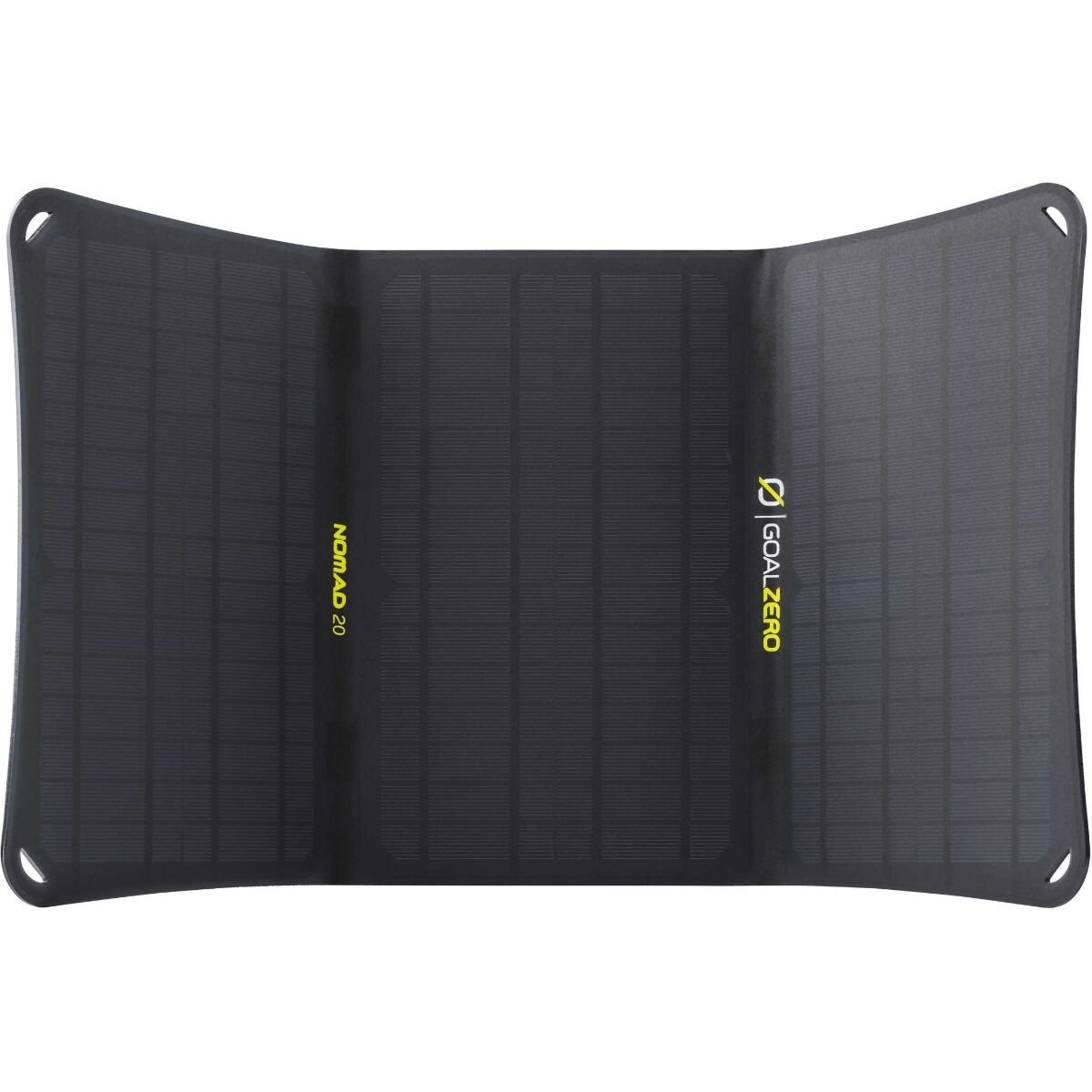
The Nomad folds to about the footprint of a paperback field guide and fits upright beside a water bottle in many daypacks. Its most useful feature for a small camp is the USB-A port. You can set the panel outside your tent, charge a power bank during the day and use the bank to top up your phone after sunset.
One detail matters before you buy. The panel is rated at 20 watts, but its USB port supplies up to 10.5 watts. If you only need one phone charge over a weekend, compare its 2.28 lb weight with the weight of taking a charged power bank alone. The panel earns its place on longer trips with regular stops in open sun. See Goal Zero’s Nomad 20 specifications.
2. Jackery SolarSaga 100W Air for weekend car camping
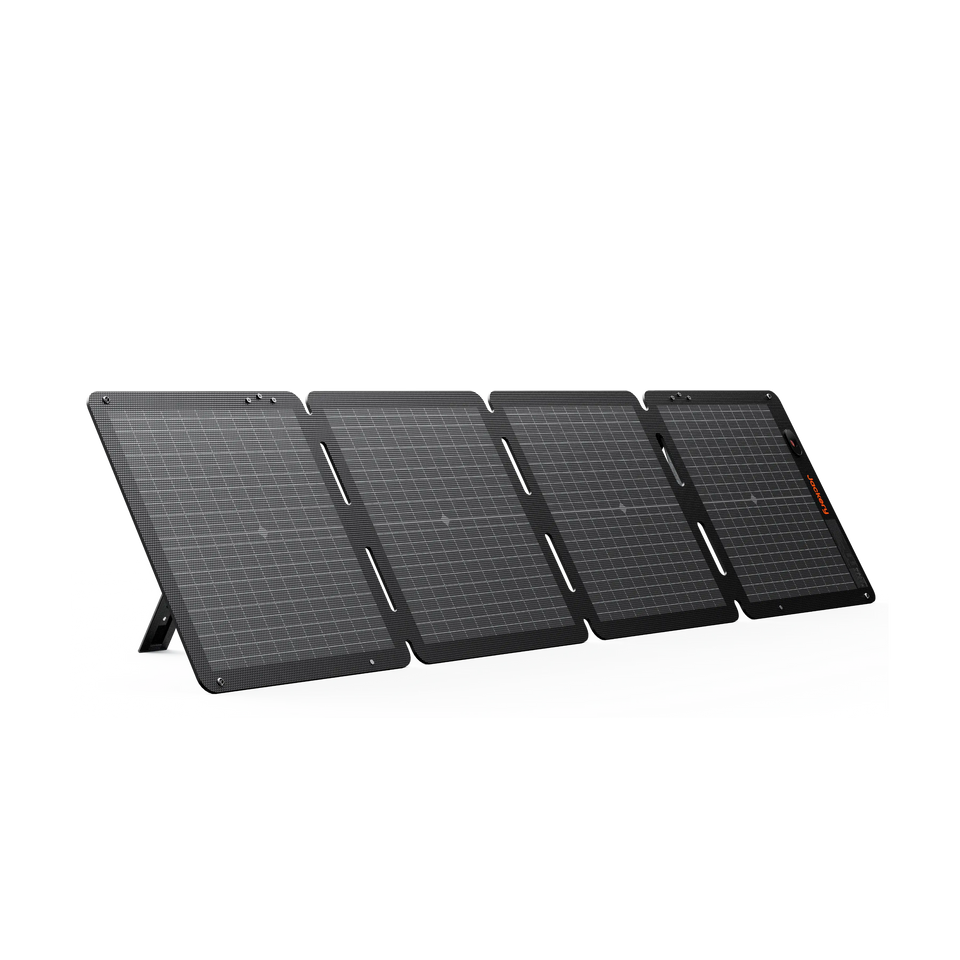
The Air is our middle pick for a couple sharing a small power station. Its four sections fold into a roughly 17-inch square, which makes it easier to stow under bedding than a long two-section panel. At camp it opens to about 64 inches wide. Measure that distance across your sunniest patch before choosing where to pitch.
Check the model code on the listing. These figures apply to the JS-100H. Jackery lists a DC8020 plug, a DC7909 adapter and a 3-meter cable. Its USB-C port delivers up to 15 watts, useful for a phone. If a laptop needs 65-watt USB-C charging, connect it to a suitably rated power station instead. Check Jackery’s 100W Air specifications.
3. EcoFlow NextGen 220W Bifacial for a powered cooler at base camp
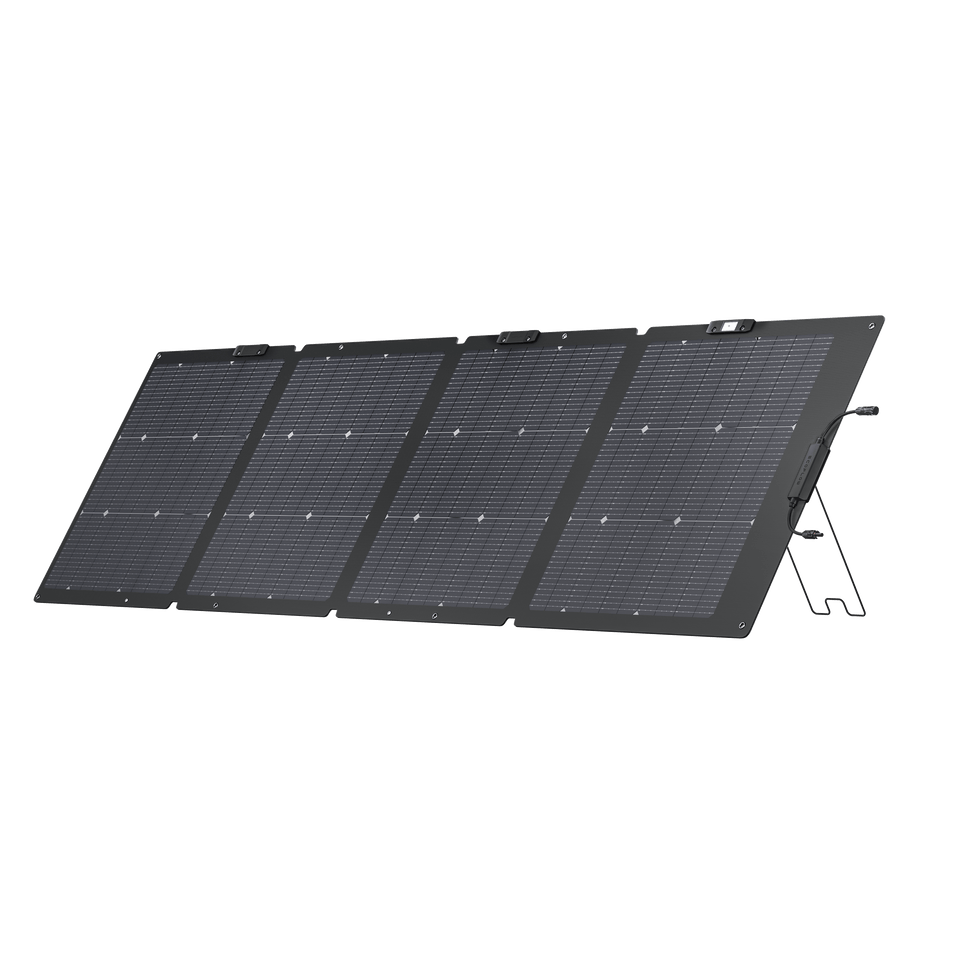
This is the pick for a family leaving a station and 12-volt cooler at one campsite for several days. The 220-watt front face gives a compatible station more opportunity to replenish what the cooler used overnight. The adjustable stand helps you aim the panel again after lunch, when the morning position may already be shaded.
The trade-off shows up when you unfold it. At nearly 85 inches wide, it needs more than seven feet of clear space. Its rear face can use reflected light, but the two face ratings should never be added together as your expected output. Size your setup using the front rating and allow for weather. See EcoFlow’s NextGen dimensions and electrical ratings.
How to choose portable foldable solar panels for camping
Compare packed dimensions first. When comparing portable foldable solar panels for camping, picture the last stretch from your car to the tent. A 15-pound panel is reasonable beside a parked camper. That same panel gets awkward on a half-mile walk when your other hand is holding the cooler. Measure the opening of the storage bin or trunk compartment as well as the space inside.
Read the solar-input label on your station. Match the manufacturer’s permitted voltage range, current rating, wattage limit and connector to the panel. A matching plug alone tells you little about electrical compatibility. For example, Jackery lists a 30-volt nominal open-circuit voltage for the Air, with a tolerance of ±5%. If your station accepts only 25 volts maximum, rule that pairing out. An adapter changes the plug shape, not the voltage.
Check where the sun and the cable will reach. A shady picnic table is a good place to sit, but a poor place to unfold a panel. Measure the distance to an open patch. Keep the station within its operating temperature range and the cable clear of the path between the tent and the car. If you’re comparing other folding designs, our ALLPOWERS solar panels review covers more options.
Sizing portable solar panels for camping with a cooler
Start with the energy you used yesterday, expressed in watt-hours (Wh). Suppose your cooler averaged 12 watts over a full day, including the time its compressor was off. That’s 288 Wh. Add 40 Wh for phones and lights, and you have 328 Wh to replace. Using the cooler’s running wattage for every hour would exaggerate that total.
For an illustrative estimate, allow four equivalent hours of full sun and assume 75% of panel-rated energy reaches storage. A 100W panel would yield about 300 Wh (100 × 4 × 0.75). A 220W panel would yield about 660 Wh on the same assumptions, provided the station accepts the input. The smaller panel falls slightly short in this example. With only two equivalent sun hours, even the larger one yields about 330 Wh, leaving almost no margin.
Use your station’s input display at camp to check the estimate. If it shows 60 watts coming in and the cooler is drawing 35 watts, only the difference is available to recharge the battery before losses. That explains why the battery percentage can climb slowly even on a bright afternoon.
Common questions about portable solar panels for camping
Will a camping solar panel work under trees?
It may produce some power, but a shadow moving across the cells can cut output. Try moving the panel a few feet and compare the watts on your station’s display. At a heavily wooded site, plan to arrive with enough stored charge to cover the essentials.
Can a folding solar panel run my cooler overnight?
The battery supplies the cooler after dark. Check the cooler’s overnight watt-hour use against the usable capacity of your power station. Then compare panels by how much of that energy they can replace during the next day’s charging window.
Which portable solar panels for camping pack smallest?
The Nomad 20 takes up the least room in a backpack. For a typical car-camping weekend with a compatible station, the SolarSaga 100W Air offers the best balance here between carry weight and charging capacity. Choose the Nomad 20 when you only need USB charging. Step up to the EcoFlow 220W when your measured daily use justifies it and your campsite has space for the full panel.