
We may earn money or products from the companies mentioned in this post.
The best solar powered generator for RV use is the one that starts your biggest appliance and keeps your essentials running until you can recharge. For weekend trips, start with the Jackery Explorer 1000 v2. For longer stays off-grid, look at the expandable BLUETTI AC200L. For heavier loads and a 120V RV outlet, compare the BLUETTI Apex 300.
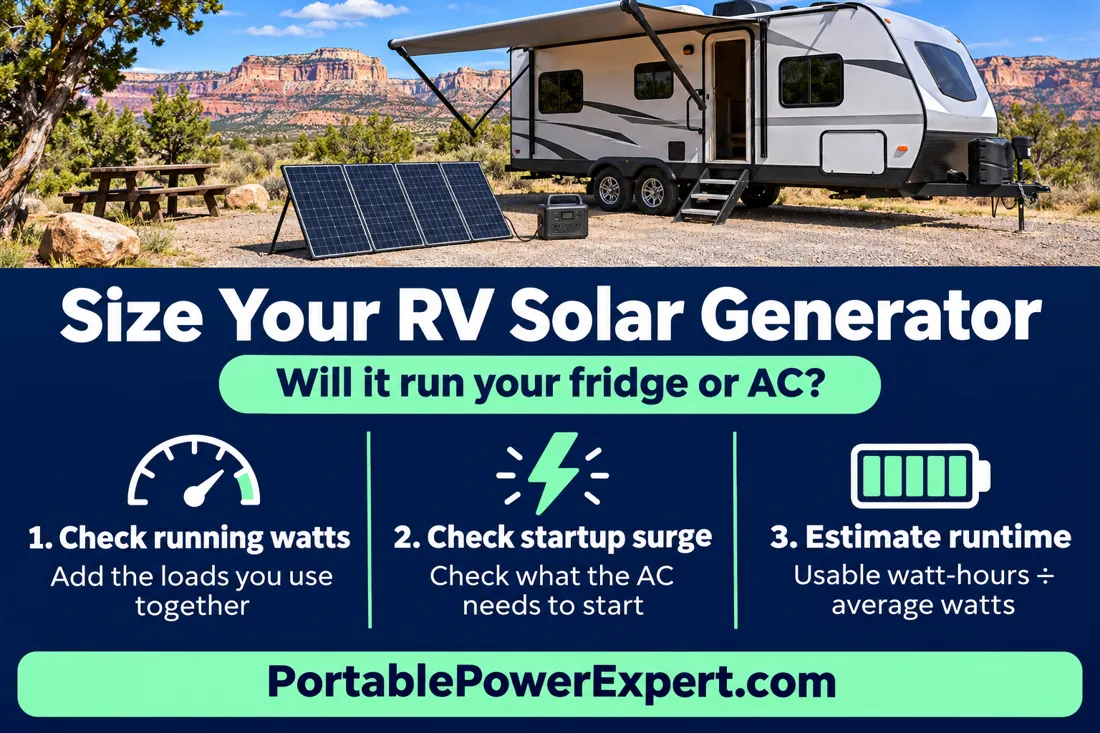
Can it run your fridge or air conditioning? A fridge can be a practical battery load once you know its daily energy use. A rooftop AC asks more of both the inverter and battery. Check startup surge separately, then work out how many hours the battery can deliver at the AC’s actual load.
Table of Contents
3 solar powered generator options for RV trips
When comparing a solar powered generator for RV trips, check both battery size and rated AC output. These picks are based on manufacturer specifications and the kinds of loads RV owners typically need to compare. Specs are for US models. Check what’s included in your bundle, especially panels, cables and expansion batteries.
| Power station | Best fit | Base capacity | Rated AC output |
|---|---|---|---|
| Jackery Explorer 1000 v2 | Weekend essentials | 1,070 Wh | 1,500 W |
| BLUETTI AC200L | Longer off-grid trips | 2,048 Wh | 2,400 W |
| BLUETTI Apex 300 | Heavier loads and expansion | 2,764.8 Wh | 3,840 W total |
1. Jackery Explorer 1000 v2 — best for weekend essentials
Choose this size if you mainly need to run lights, charge phones or laptops, and power a fridge with a measured daily draw that fits the battery. The 1,070 Wh battery gives you about 910 Wh of usable AC energy under the 85% planning assumption used below. That’s a useful starting budget for a night away, especially if you’ll recharge the following day.
Run selected appliances from the station’s own outlets. If overnight AC or powering the RV through its shore inlet is central to your plan, start by comparing the larger picks and checking your RV’s requirements. See Jackery’s US specifications and solar bundles.
2. BLUETTI AC200L — best for longer stays off-grid
The AC200L gives you 2,048 Wh of base capacity and 2,400 W of rated AC output. That extra capacity helps if your fridge, devices and lighting need to last into the next day. You can add compatible battery capacity later. BLUETTI lists up to 1,200 W of solar input, which gives you more room to build a recharge setup around longer trips.
It also has a 120V TT-30 outlet. Check the 2,400 W total inverter rating against what you’re asking it to power. If the RV’s converter starts charging the house battery, include that extra demand in your estimate. See the AC200L specifications.
3. BLUETTI Apex 300 — best for higher running loads
The Apex 300 combines 2,764.8 Wh of base storage with 3,840 W of rated AC output in total. It has a 120V TT-30 outlet and supports compatible expansion batteries. Consider it if a smaller inverter falls short for your measured loads, or if you expect to add battery capacity as your trips get longer.
For rooftop AC, compare your unit’s startup requirements and running draw with the generator’s documented limits. The extra inverter output can help with demanding loads, while adding battery capacity extends runtime. Budget for the extra weight and space before deciding on a bundle. See BLUETTI’s US Apex 300 specifications.
How to size a solar powered generator for RV use
- Add simultaneous running watts. List the things you’ll use at once. A fridge, laptop and lights are one load profile. Adding a microwave or air conditioner can change the inverter size you need.
- Check startup demand. Compressors can draw more power while starting. Check your appliance’s documentation and the generator’s rated surge performance, including how long that surge is supported.
- Add watt-hours between recharges. Multiply watts by hours for each appliance and add the results. For a cycling fridge, use measured energy over a representative day if possible.
Divide your expected AC energy use by 0.85 for a rough battery sizing estimate. For example, if your essentials use 850 Wh between charges, start with about 1,000 Wh of rated capacity. Leave extra room if you expect hotter conditions, variable solar or loads you haven’t measured. Use our portable power station calculator to run your own numbers.
Can a solar powered generator for RV use run a fridge or AC?
The examples below use a full battery, no incoming solar and 85% of rated capacity as usable AC energy. They also assume the generator can start the appliance. They are sizing examples, and actual runtime will depend on cycling, inverter overhead, temperature and other loads.
| Example load | With a 1,000 Wh battery | With a 2,000 Wh battery |
|---|---|---|
| Fridge averaging 50 W over time | About 17 hours | About 34 hours |
| AC drawing 1,200 W continuously | About 43 minutes, if the inverter supports it | About 85 minutes, if the inverter supports it |
A 50 W average is equivalent to 1.2 kWh per day, so measure before buying. For a 120V plug-in fridge, a plug-in energy meter can capture a full day’s consumption. If yours runs on the RV’s 12V system, use the DC energy consumption and account for the connection method. An absorption fridge running in electric mode can have a very different energy budget than a compressor fridge. Sustained AC use can quickly make a larger battery and a dependable recharge plan worthwhile.
A one-night RV power budget
Say your fridge uses 540 Wh between dinner and breakfast, your lights draw 15 W for four hours, and your laptop pulls 60 W for two hours. That’s 720 Wh in total before any other loads. At 85% usable AC energy, you’d need about 850 Wh of rated battery capacity for those three loads. If your fridge uses more on a warm night, or you need to cover a second night without solar, use the larger energy budget to compare models.
Now check the watts separately. If you make coffee with a 900 W appliance while the fridge compressor runs at 90 W, the two draw about 990 W together while running. The inverter also needs enough headroom to handle startup demand. If your unit is close to its limit, unplugging or switching off an optional load before starting another gives you a more manageable load profile. Make this check before you pick a solar powered generator for RV trips.
Use a realistic recharge window, too. If check-out is early and you usually park in shade, you may have little useful solar before you leave. Size for the longest stretch between reliable charges, then consider solar, a manufacturer-approved vehicle charging setup, or campsite power as ways to refill the battery.
Plan how you’ll recharge between uses
For a solar powered generator for RV trips, match the panel setup to the amount of energy you use each day. Panel wattage is a rating. Daily energy depends on usable sun, shade, weather and how you position the panels. An array averaging 200 W of actual input for four hours adds about 800 Wh at the input before charging losses. That may cover some essentials, but it is less than the energy a 1,200 W AC draws in one hour. Track the station’s actual solar input and check how much your battery recovers from one afternoon to the next.
Before buying panels, match the station’s voltage, current and connector requirements using the manufacturer’s instructions. For campsites that vary between open sun and deep shade, see our portable solar panel coverage for options you can position away from the RV.
Common RV solar generator questions
Can a solar powered generator for RV use connect to shore power?
Start with the RV and generator manuals. Check whether the generator supports the connection, the outlet type and the total permitted load. A TT-30 outlet can be helpful for a compatible 120V RV. The generator’s inverter still sets the power available. Avoid improvised adapters or wiring and have an RV technician confirm any hardwired setup.
Can I use it at night?
Yes. The power station stores energy in its battery and can supply compatible loads after dark. Size it for the full period you expect to go between charges, especially if you plan to run a fridge overnight and park in the shade the next morning.
Do solar panels come with the generator?
Check what the seller includes. A power station listing may be battery-only, while a solar generator bundle typically adds at least one panel. Compare the included panel capacity, cables and connectors against your recharge plan before ordering.
Which solar powered generator for RV trips should you choose?
Start with the Jackery for weekend essentials, the AC200L if you want room to expand for longer trips, or the Apex 300 for heavier simultaneous loads. Before buying, measure your fridge’s daily draw, check your AC’s startup requirements if you plan to run it, and work out how you’ll recharge at the places you actually camp.