
We may earn money or products from the companies mentioned in this post.
Choose a 240V solar generator by checking three things first: U.S. 120/240V split-phase output, enough power to start and run your appliance, and enough battery capacity for the outage you want to cover. A well pump that runs for minutes at a time and a central air conditioner that runs for hours can lead to very different purchases.
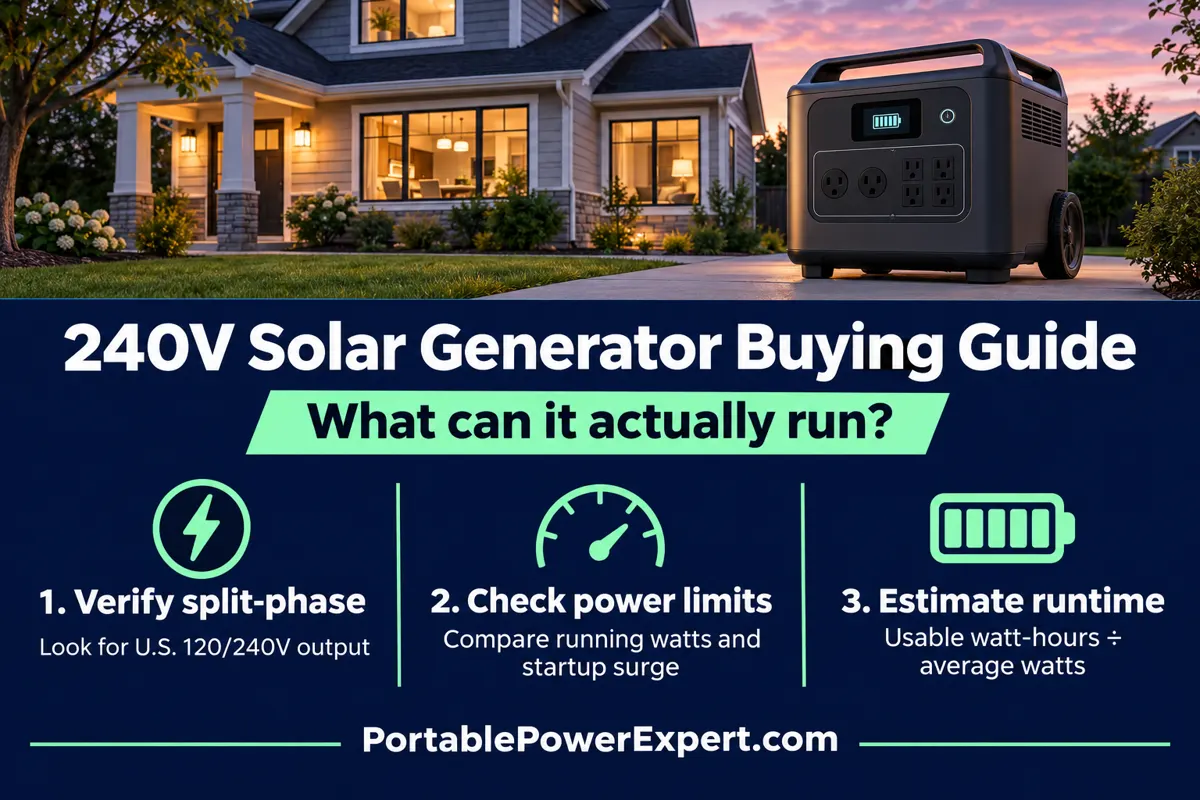
Our three picks are the BLUETTI Apex 300 + B300K for more stored energy at a modest output, the EcoFlow DELTA Pro 3 for a single-box setup, and the EcoFlow DELTA Pro Ultra for higher simultaneous loads. The best choice depends on what you need to keep running and how long you need it.
Table of Contents
3 best 240V solar generator setups compared
These are specification-based picks for U.S. equipment. Output is the rated total for the configuration shown. Check the manual for the limit of the specific outlet, the available output in the mode you intend to use, and any 120V limits per leg. Battery size is nominal, and solar panels may be sold separately.
| Setup | Rated AC output | Battery capacity shown | Best fit |
|---|---|---|---|
| BLUETTI Apex 300 + B300K | 3,840 W total | 5.53 kWh | Longer runtime for selected loads |
| EcoFlow DELTA Pro 3 | 4,000 W total | 4.10 kWh | Single-box starting point |
| EcoFlow DELTA Pro Ultra | 7,200 W total | 6.14 kWh with one battery | More inverter headroom |
1. BLUETTI Apex 300 + B300K — best for longer runtime at moderate loads
The U.S. Apex 300 provides 120/240V output from one power station. Its onboard battery is about 2.76 kWh. Adding one B300K brings rated storage to about 5.53 kWh while the single inverter remains rated at 3,840 W total. That makes this bundle worth comparing if your measured loads fit the inverter and you mainly want more time between recharges.
The 120/240V outlet is a NEMA 14-50R, but check the unit’s documented output limits. The receptacle style alone does not establish the available power. Compare the BLUETTI U.S. specifications with your appliance requirements, then see our BLUETTI Apex 300 + B300K bundle for current options.
2. EcoFlow DELTA Pro 3 — best single-box starting point
The U.S. DELTA Pro 3 combines a 4,096 Wh battery and 4,000 W of rated AC output. It offers 240V and 120/240V outlet options. EcoFlow rates the relevant outlets at 16.7 A, so a locking connector marked 30 A should never be taken as a promise of 30 A from one unit. Check the manual for outlet behavior in your intended operating mode.
Choose this size if you want a one-unit starting point and your expected runtime fits about 4.1 kWh of rated storage. Extra batteries can help cover longer outages. Use the continuous rating for your load plan, and check the manufacturer’s surge specifications separately for motor starts. See EcoFlow’s U.S. DELTA Pro 3 details.
3. EcoFlow DELTA Pro Ultra — best for higher combined loads
One DELTA Pro Ultra inverter and one battery give you 7,200 W of rated 120/240V discharge output and 6,144 Wh of rated storage. This 240V solar generator setup makes sense if your planned loads are too demanding for the roughly 4 kW options, or you need more flexibility to run multiple circuits together.
The high inverter rating is useful for short periods of heavy demand. For long outages, figure out how much energy you need through the night and whether you’ll want additional batteries. Compare the U.S. DELTA Pro Ultra specifications and price the complete setup, including any home integration equipment.
Does a 240V solar generator need two units?
Check the exact U.S. model number and its manual. All three picks can provide 240V output with one inverter in the configurations shown. Other products may require two compatible power stations and the manufacturer’s approved pairing accessory. An expansion battery adds stored energy. Check separately whether the setup needs a second inverter for more output.
U.S. 120/240V split-phase has two 120V legs and 240V between them. When comparing equipment for a mix of 120V and 240V household circuits, look for explicit documentation of the split-phase output. A 240V-only label on an overseas product doesn’t establish compatibility with a U.S. home.
What can a 240V solar generator actually run?
Use the appliance nameplate or manufacturer data for voltage and running requirements. For motor or compressor loads, check startup requirements as well. A well pump may draw power for a short time but still have a demanding start. Central air can combine high startup demand with substantial energy use over several hours. An electric dryer or range can consume a large share of available power while heating, especially alongside other loads.
| Load | First check | What changes the decision |
|---|---|---|
| Well pump | Voltage and starting demand | How often the pump runs and what else runs with it |
| Central AC or heat pump | Compressor start and running requirements | Cooling or heating duty cycle and any auxiliary electric heat |
| Electric range or dryer | Draw in the modes you actually use | Whether you can defer use until grid power returns |
| 120V fridge, lights and router | Combined load and generator limits per leg | How the backed-up circuits are distributed |
Write down what you’ll run simultaneously. If your planned running load is 3,500 W on a unit rated for 4,000 W total, there is roughly 500 W of space under the total running limit. That figure alone tells you very little about whether a compressor can start. You still need to compare the startup demand, output mode and relevant outlet limit.
How to estimate 240V solar generator runtime
Divide usable battery energy in watt-hours by average load in watts. As a planning example, assume 85% of rated battery energy reaches the AC loads. Actual performance will vary with temperature, inverter overhead, discharge rate and other loads. These estimates start with a full battery and assume no solar recharge.
| Rated battery | At 500 W average | At 2,000 W average |
|---|---|---|
| 4.10 kWh | About 7 hours | About 1 hour 45 minutes |
| 5.53 kWh | About 9 hours 24 minutes | About 2 hours 21 minutes |
| 6.14 kWh | About 10 hours 26 minutes | About 2 hours 37 minutes |
For a practical outage plan, estimate the 120V essentials as well as the 240V appliance. Suppose your essentials average 200 W over eight hours and a 1,500 W load runs for 40 minutes during that window. That’s roughly 2.6 kWh of total AC energy. At 85% usable energy, you’d want about 3.06 kWh of nominal battery capacity before allowing room for uncertainty. Use the portable power station calculator with your own appliance figures.
Worked example: an overnight outage with a well pump
Imagine you want a 240V solar generator to keep a well pump, fridge, router and a few lights available through a 12-hour outage. For this example, assume the 120V essentials average 150 W over that period and a 240V pump draws 1,200 W while running for a combined 30 minutes. Plug your own numbers in before using this example to choose equipment.
The essentials use 1,800 Wh over 12 hours. The pump uses a further 600 Wh, bringing the total to 2,400 Wh. Divide that by 0.85 and you get about 2,825 Wh of rated battery capacity. A battery around that size leaves little room for changes to the plan. A battery just over 4 kWh provides more headroom for a longer outage or a pump that cycles more often than expected.
Now check the pump’s starting requirements. Your 240V solar generator needs to deliver the pump’s documented startup demand while other backed-up loads are present. If the pump needs more surge capacity than the inverter can supply, choose an inverter that can support it. Adding battery capacity to the same inverter solves the separate problem of runtime.
For the next day, treat recharge as its own budget. If you used 2.4 kWh overnight and your panels deliver an average of 500 W at the input for four hours, that is around 2 kWh before charging losses. If you are still running appliances while charging, less energy is available to refill the battery. If two cloudy days are common where you live, price the storage for a longer stretch or decide which loads you can drop until the grid returns.
Compare the full cost of each setup
Make a shortlist with one row per complete configuration. List the inverter, usable energy estimate, solar panels, and the required equipment for the circuits you want backed up. If a retailer lists a 240V solar generator as a bundle, check the battery count and panel wattage against the exact variant you’re buying. Bundle names often cover several different configurations.
Ask the electrician to confirm which circuits the quote includes. For example, you might prioritize the pump, the fridge and one lighting circuit, then leave the dryer and other high-demand appliances on utility power. That can change which inverter size makes sense and how much battery capacity is worth paying for.
Finally, compare how you’d recharge after a night of use. A 240V solar generator that covers one outage comfortably may still need more panel capacity to repeat the same schedule the following day. If your main goal is to get through a single evening, compare on that basis. If you want several days of backup, compare on daily energy use and likely recharge together.
What to budget for home backup
For hardwired loads or panel backup, have a qualified electrician verify the generator’s compatibility and install the appropriate transfer equipment to isolate the home from the grid. Never feed power into a home through a wall receptacle. See OSHA’s portable generator safety guidance. Ask for a quote that lists the circuits you’ll be able to back up and any operating limits you need to account for.
Compare the complete cost of the inverter, batteries, panels and any approved accessories. A solar input rating describes how much the unit can accept under suitable conditions. Plan around what your panels can realistically supply during an outage, and size the battery to cover overnight use or poor weather. If all the loads you plan to back up use 120V, start with our broader home solar generator comparison for more options.
240V solar generator FAQs
Does 240V make the battery last longer?
Runtime mainly depends on usable battery capacity and average power draw. A load consuming 1,000 W for an hour uses 1,000 Wh, regardless of the supply voltage. Compare expected energy use as well as the voltage the appliance requires.
Can I size for central AC by tonnage alone?
Use the model’s electrical data and have your HVAC technician or electrician confirm the running and startup requirements. Two units of the same cooling capacity can have different electrical demands. Include other circuits you’ll use when the AC starts.
Which 240V solar generator should you buy?
Start with the Apex 300 bundle if your measured loads fit its output and longer runtime is the priority. Compare the DELTA Pro 3 if you want an integrated 4.10 kWh unit. Move up to the DELTA Pro Ultra if the numbers show that you need more inverter headroom. Before ordering, confirm your largest startup load and price the battery capacity you’ll need for a full outage window.
Before you order a 240V solar generator, ask for the exact U.S. model number and download its manual. Save the outlet ratings and the approved connection options with the retailer quote. If you’re relying on a particular unit to start a pump or compressor, ask the installer how that load will be checked during commissioning. That gives you a concrete way to verify that your backup setup covers the circuit you bought it for.
Affiliate disclosure: We may earn a commission if you buy through a link on this page.