
We may earn money or products from the companies mentioned in this post.
The best small solar generator is the one you can carry with its panel and recharge fast enough for the gear you bring. A solar generator kit pairs a portable power station with a compatible solar panel. The panel charges the battery, and the station powers your devices.

Quick answer: The Jackery Explorer 300 Plus pairing is the lightest on paper if you can source both pieces. The BLUETTI Elite 30 V2 + 100W is the compact weekend pick. Choose the BLUETTI Elite 100 V2 + 200W if running a compressor cooler matters more than carrying weight.
Table of Contents
Best small solar generator kits compared
Weights below combine the station and panel and exclude loose cables and bags. The Jackery estimate depends on which folding SolarSaga 100W revision you buy. The BLUETTI estimates use the manufacturer’s listed panel weights. We compared published specifications and calculated planning examples.
| Kit | Approx. combined weight | Battery | Rated AC output | Panel | Max. solar input |
|---|---|---|---|---|---|
| Jackery Explorer 300 Plus + SolarSaga 100W | About 16–19 lb, depending on panel revision | 288 Wh | 300 W | 100 W | 100 W |
| BLUETTI Elite 30 V2 + 100W | About 20.4 lb (9.5 + 10.9) | 288 Wh | 600 W | 100 W | 200 W |
| BLUETTI Elite 100 V2 + 200W | About 44 lb (25.3 + 18.6) | 1,024 Wh | 1,800 W | 200 W | 1,000 W |
Before ordering, check the cart for both the station and the panel. Some listings default to the station on its own. If you need a larger selection for a car camping setup, see our camping solar generator roundup.
1. Jackery Explorer 300 Plus + SolarSaga 100W — lightest pairing
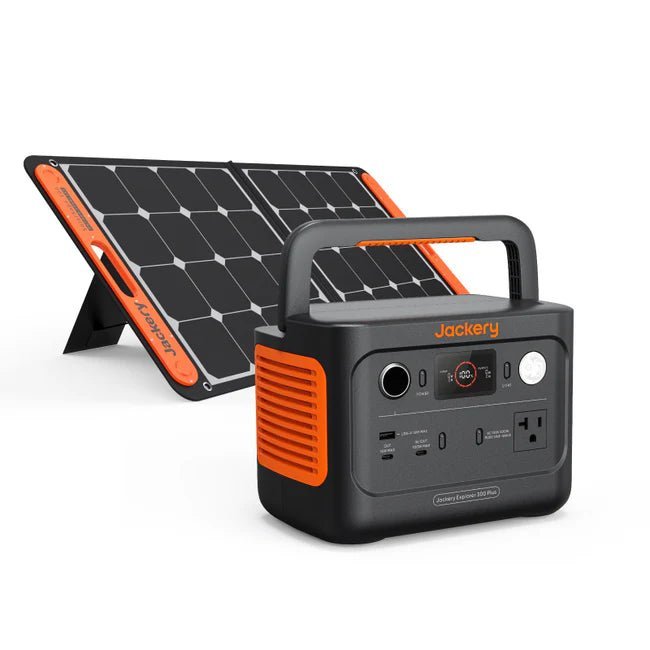
The Explorer 300 Plus weighs about 8.3 lb on its own. A folding SolarSaga 100W adds roughly 8–10 lb depending on the revision. It’s a good size for a road trip where you’re charging phones and a laptop and running a small light or fan in the evening.
At our planning allowance of 85% of rated capacity, a full battery provides about 245 Wh of usable AC energy. A 20 W fan could run for about 12 hours on paper. If you also use 60 Wh for a laptop recharge, the remaining battery budget for that fan drops to about nine hours. A 100 W panel could bring in about 280 Wh on a day with four equivalent peak-sun hours at 70% of rated output, before any further battery charging losses.
Trade-off: The 300 W inverter is intended for modest loads. Check the solar charging adapter for the exact SolarSaga revision. The U.S. bundle was unavailable at listings we checked, so treat this as a pairing for readers who can source both pieces. See the Jackery Explorer 300 Plus specifications.
2. BLUETTI Elite 30 V2 + 100W — best compact weekend kit
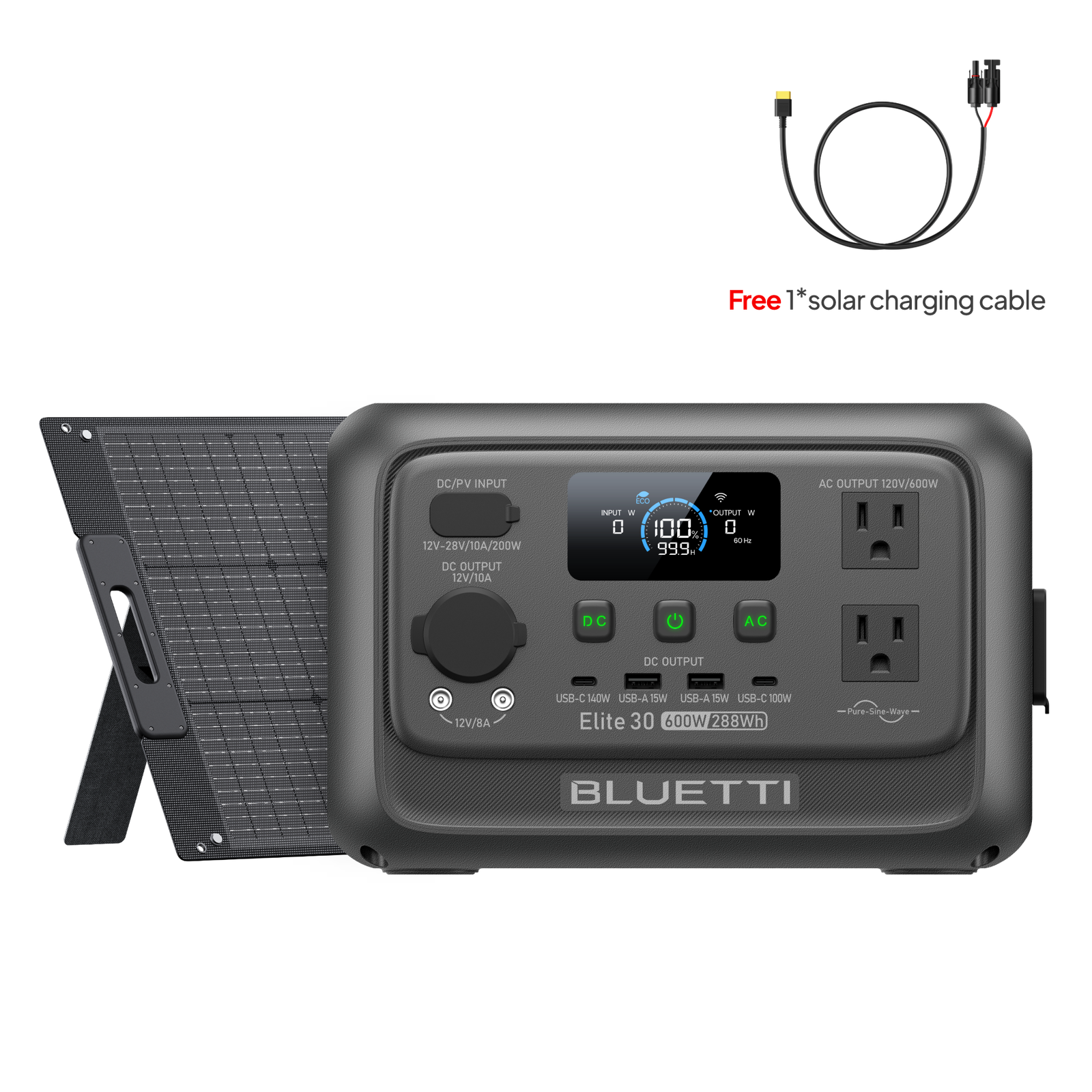
The Elite 30 V2 also stores 288 Wh, with a 600 W continuous AC rating. That gives you extra room to run several modest devices at once. The battery-only runtime stays in the same ballpark as the Jackery at a matching draw. With its 100 W panel, the combined carry weight is about 20.4 lb.
On battery alone, a 50 W projector would use about 200 Wh in four hours, leaving roughly 45 Wh in the planning budget. If you add a laptop or lights, shorten the projector session or recharge first. Four equivalent peak-sun hours at 70% of panel rating gives about 280 Wh at the solar input before further losses. Any load running during that window reduces what can go back into the battery.
Trade-off: Higher inverter output can empty a small battery quickly. A 500 W appliance would use the estimated 245 Wh battery budget in about half an hour, potentially less in practice. The station can accept up to 200 W from compatible solar equipment. Check voltage and current against the manual if upgrading. See the exact U.S. Elite 30 V2 + 100W kit.
3. BLUETTI Elite 100 V2 + 200W — best for longer cooler runtime
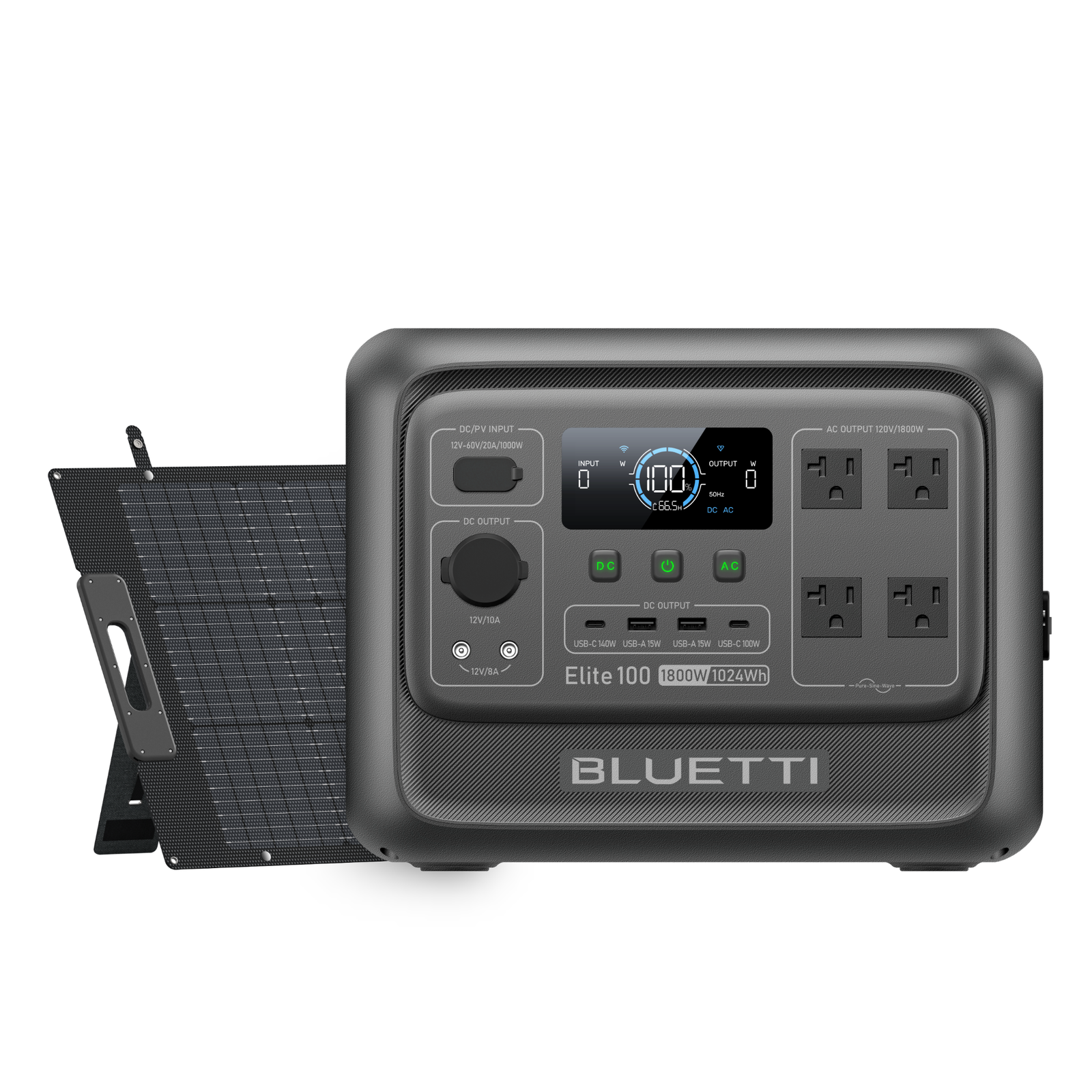
The Elite 100 V2 has 1,024 Wh of storage and a rated 1,800 W AC inverter. At about 44 lb for the station and panel together, it suits car camping, van trips and short outages where you can set it down for the day. The larger battery is the reason to choose it for a cycling compressor cooler.
Battery alone: At 85%, plan around 870 Wh of usable AC energy. A compatible cooler averaging 350 Wh per day could run about 60 hours in this simplified example, with no other loads. If it averages 450 Wh in hotter weather, the estimate drops to about 46 hours. Measure your own cooler over a full day in representative conditions to get a better estimate. For a compatible 12 V connection, use the cooler’s measured DC draw and verify the port’s rating.
With solar: A 200 W panel at 70% output for four equivalent peak-sun hours could contribute about 560 Wh at the input before charging losses. That may offset much of the cooler’s use on a good day. Shade and clouds can cut the harvest, and any additional appliances increase the daily energy budget.
Trade-off: The complete kit takes more space and is over twice the carry weight of the Elite 30 V2 setup. BLUETTI also displayed a shipping lead-time notice for this model when checked. Verify delivery before relying on it for a trip. See the U.S. Elite 100 V2 + 200W kit.
How to size the best small solar generator for your gear
Make a list of the devices you’ll run together and check their combined running watts. If one has a motor or compressor, confirm that the station can meet its starting demand as well. Next, multiply each device’s watts by the hours it runs to get watt-hours. For cycling equipment, use daily energy consumption or an average drawn from measurements.
Suppose you run a 10 W camping light for five hours, a 20 W fan for six hours, and recharge a laptop that needs 60 Wh. The total is 230 Wh. A 288 Wh station at 85% usable energy gives a planning budget of about 245 Wh, so there’s only about 15 Wh left before other loads and variations. If you want a second night, plan to recharge or bring more capacity. Run your own numbers in the Portable Power Station Calculator.
Use the 85% allowance as an estimate for portable AC use. Actual energy delivered depends on the inverter’s idle draw, temperature, battery condition and the load. The solar examples multiply panel rating by equivalent peak-sun hours and a 70% allowance. They estimate energy at the input. The battery receives less after charging losses, and may accept less when nearly full or too cold.
Should you buy two to five solar panels?
If you camp off-grid regularly, start with two compatible panels when your station can accept the extra input. More usable solar watts can shorten charging time and leave more energy in the battery at sunset. The battery still holds the same maximum amount, so plan overnight runtime around its capacity.
For the Jackery Explorer 300 Plus, the 100 W solar input limit makes one compatible 100 W panel the practical choice. The BLUETTI Elite 30 V2 accepts up to 200 W, so a compatible two-panel setup totaling 200 W is worth considering if you want to recharge faster.
For the BLUETTI Elite 100 V2, two 200 W panels give you 400 W of rated solar. That’s a good starting point for a cooler and other daytime loads. If you spend several days off-grid, compare three to five panels for faster recovery between nights. Five 200 W panels add up to 1,000 W on paper, the station’s stated input ceiling. Before buying, confirm the manufacturer supports your exact combination within the voltage, current and connector limits. Shade, clouds and charging losses will affect how much energy you actually get.
Small solar generator FAQs
Does a small solar generator come with a panel?
Choose the listing that names both pieces. The BLUETTI options compared here are kits with panels listed. The exact Jackery pairing may require sourcing the station and a compatible SolarSaga revision separately. Verify that the required charging adapter is included or available before buying.
How long does a 100 W panel take to recharge a 288 Wh battery?
Using the example above, four equivalent peak-sun hours produces about 280 Wh at the input. A full charge from empty can take longer once charging losses and lower output are taken into account. If you need your battery full when you arrive, charge it from a wall outlet before leaving and treat solar as a top-up.
Will a compact kit keep food cold for a weekend?
Measure the cooler’s daily energy use and multiply by the number of days you expect to be away. At 350 Wh per day, two days use about 700 Wh. The 1,024 Wh station has enough estimated usable energy for that example on battery alone. The 288 Wh options would need recharging sooner. Factor in ambient temperature and any lights or electronics sharing the same battery.
Which compact kit should you choose?
Pick the Jackery pairing if minimizing weight matters most and you can find both components. Choose the Elite 30 V2 kit for compact weekend use with more AC output. Take the Elite 100 V2 kit when a cooler will run for longer and you can move the heavier setup by car. In each case, compare the weight of both pieces and plan how you’ll recharge before ordering.