
We may earn money or products from the companies mentioned in this post.
Choosing a PECRON battery starts with one question: do you need a complete portable power station, more capacity for an existing station, or a separate battery for a purpose-built electrical system? Those products serve different jobs, and similar model names do not guarantee compatibility.
This guide explains how to compare the options, calculate useful capacity and avoid buying the wrong expansion pack. It is based on manufacturer documentation, not hands-on testing. Product compatibility can change with model revisions, so confirm the exact pairing before ordering.
Which PECRON battery do you need?
| Product type | Best starting point for | What to check |
|---|---|---|
| Portable power station | A self-contained power source for plug-in devices | AC voltage, inverter rating, capacity and charging inputs |
| Expansion battery | Longer runtime from a compatible existing station | Exact host model, battery revision and connection cable |
| Standalone deep-cycle battery | A designed RV, marine or other DC electrical system | System voltage, charger, protection and inverter compatibility |
A complete station brings battery storage and power conversion together. An expansion pack adds energy to a supported system but should not be assumed to provide the same sockets or standalone functions. A deep-cycle battery is another category again: it is not a direct substitute for a complete power station.
For example, PECRON’s current US catalogue includes the F3000LFP power station and separate expansion batteries. Start with the function you need, then compare the products within that category.
PECRON battery compatibility: match the complete name
Pay close attention to letters and voltage suffixes. EB3000-24V, EP3000-48V and EP3800-48V are distinct names. A battery with “3000” in its name is not automatically compatible with every PECRON station containing a similar number.
PECRON’s European EP3000-48V listing specifies 3,072Wh and names E1500LFP, E2400LFP, F3000LFP and E3600LFP as supported stations. Treat that as the stated compatibility for that listing, rather than a promise covering every regional version and revision.
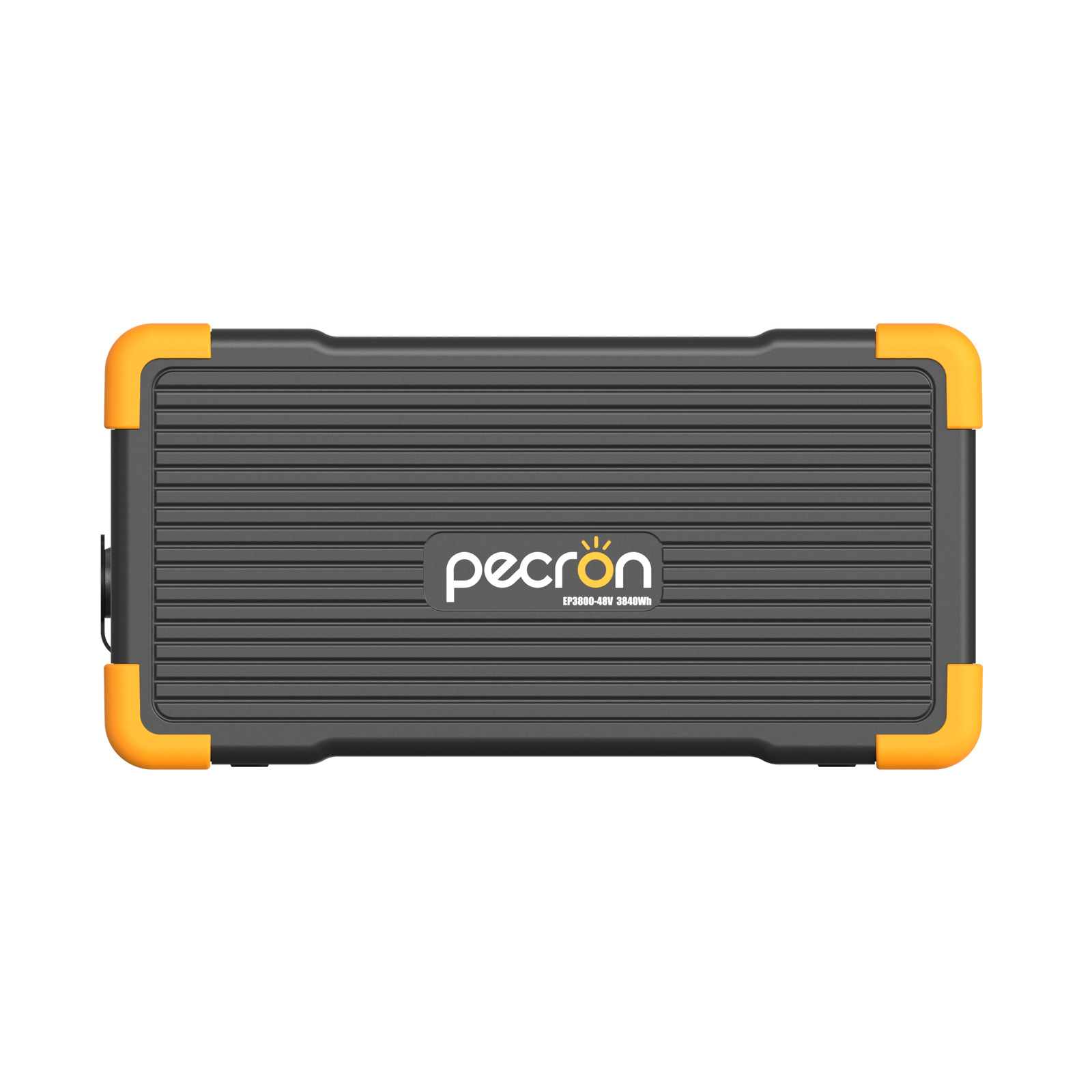
The US EP3800-48V listing describes a 3,840Wh LiFePO4 expansion pack. It specifically instructs F3000LFP owners to contact PECRON for the XT120 cascade cable. The same page describes the pack as having no independent input or output, so it should be treated as an expansion component rather than a standalone station.
Ask these questions before paying
- Is this exact battery supported by my main unit’s model and revision?
- Which connection cable is needed, and is it included?
- How many packs does my station support?
- Does the battery charge through the station, or have another approved charging method?
- Are firmware updates or particular settings required?
- Does the seller provide warranty support in my country?
Send the supplier a photograph of your model label when there is any ambiguity. Written confirmation is more useful than assuming two connectors that look similar are electrically compatible.
How much PECRON battery capacity do you need?
Calculate energy demand before comparing battery prices. For each device, multiply average watts by hours of use. Add the results to estimate the watt-hours needed for your trip or outage period. Keep maximum simultaneous watts as a separate calculation because that determines the output rating required.
| Illustrative load | Usage | Energy |
|---|---|---|
| 50W laptop load | 4 hours | 200Wh |
| 10W lighting load | 5 hours | 50Wh |
| 20W communications equipment | 10 hours | 200Wh |
| Total | 450Wh |
These are example loads, not specifications for your equipment. At an illustrative 85% usable-energy allowance, delivering 450Wh would require approximately 529Wh of rated storage: 450 ÷ 0.85. Add a reserve appropriate to your needs. Efficiency varies, especially at very low loads, and a battery’s full label capacity is not necessarily available at the wall socket.
What difference could an expansion pack make?
In a hypothetical supported system, a 3,072Wh station plus a 3,840Wh pack totals 6,912Wh nominal storage. At the same illustrative 85% allowance, that is approximately 5,875Wh available for planning. A constant 300W load would give about 19.6 hours mathematically. This is not a measured runtime or a guarantee for a particular installation.
Adding capacity does not automatically increase the main station’s inverter output. If an appliance exceeds the station’s power rating, buying another battery may not solve the problem. For cycling appliances, see our refrigerator runtime guide.
Should you expand or buy another power station?
Expansion can make sense when your current station already handles every required appliance but runs out of energy too soon. Compare the complete cost of the battery and cable against the usable extra capacity you expect.
A second station may make more sense when you need power in two places, want independent charging, or need a different output rating. You will be paying for another inverter and set of controls, but you also gain a separately usable unit.
Weight matters too. The EP3800-48V manufacturer page lists roughly 30.3kg (66.8lb) for the pack alone. Plan how you will transport and store the full system. A large station plus expansion battery can be inconvenient for frequent moves even if the energy capacity suits your appliances.
For smaller trips, use our camping sizing guide. For essential household loads, compare complete systems in our home backup guide.
PECRON battery charging and storage checks
Use the instructions for your exact battery and station. Follow the permitted temperature range, approved cables, ventilation requirements and storage charge guidance. Do not apply charging instructions from an older model to a newer expansion pack.
For solar charging, check the main unit’s input specifications and approved configuration. More storage does not necessarily mean faster charging. Your charging source must replace the energy you use over the available charging period. Our solar panel charging guide explains the planning process.
Distinguish cycle-life claims from warranties. A claimed number of cycles to a percentage of original capacity describes a test criterion; it is not a promise of the same runtime indefinitely. Confirm registration requirements, exclusions and regional support separately.
PECRON battery FAQs
Can I use any PECRON expansion battery with any station?
No. Match the exact battery and host model using manufacturer documentation and confirm any revision or cable requirements.
Will an expansion battery increase AC output watts?
Do not assume it will. Extra storage primarily addresses runtime; the main station’s supported output remains a separate limit.
Is an expansion battery a replacement for the internal battery?
No. An external expansion pack is an approved accessory for a supported station. Internal battery replacement is a service question for the manufacturer.
Are all PECRON batteries LiFePO4?
No. Check each model. PECRON’s earlier E3000 documentation identifies NCM cells, while its EP3800-48V listing identifies LiFePO4. Our battery chemistry comparison explains the terms.
Our assessment
The right PECRON battery is the one that fits your system and solves a measured energy shortfall. Start with daily watt-hours and peak load, confirm compatibility in writing, and compare the complete installed or portable setup. An attractive price per watt-hour has little value if the pack cannot connect to the station you own.
Research checked November 2026 using PECRON manufacturer product pages and documentation. Runtime figures are illustrative calculations. No hands-on performance testing is claimed.