
We may earn money or products from the companies mentioned in this post.
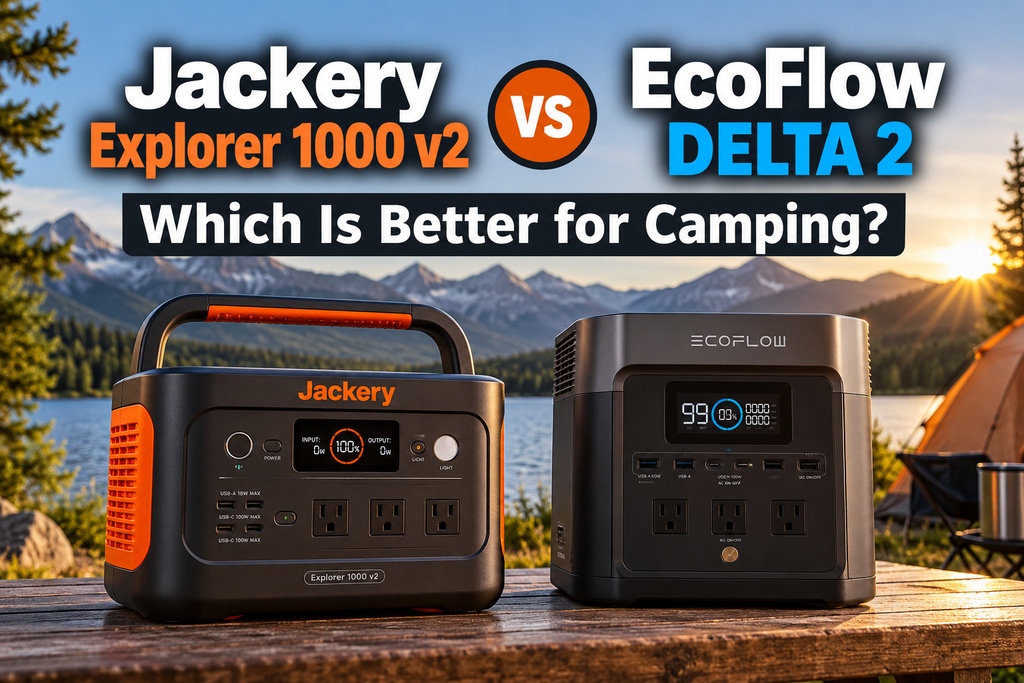
This Jackery Explorer 1000 v2 vs EcoFlow DELTA 2 comparison looks at two popular LiFePO4 portable power stations for car camping, road trips and emergency backup. The Jackery is lighter and stores slightly more energy; the EcoFlow offers higher rated AC output and battery expansion. Which matters more depends on what you need to power.
Editorial note: This is a research-based comparison of US-spec models using manufacturer documentation checked October 25, 2026. We have not hands-on tested either unit. Specifications and features can differ by region; check the exact model before buying. This article currently contains no affiliate links.
Jackery Explorer 1000 v2 vs EcoFlow DELTA 2: specifications
| Feature | Jackery Explorer 1000 v2 | EcoFlow DELTA 2 |
|---|---|---|
| Battery capacity | 1,070Wh | 1,024Wh |
| Battery chemistry | LiFePO4 (LFP) | LiFePO4 (LFP) |
| Rated AC output | 1,500W | 1,800W |
| Weight | 23.8lb / 10.8kg | Approximately 27lb / 12kg |
| Maximum solar input | 400W | 500W |
| Battery expansion | No external expansion battery | Supports compatible extra battery |
| Cycle-life claim | 4,000 cycles to at least 70% capacity | 3,000 cycles to at least 80% capacity |
These cycle-life figures use different remaining-capacity thresholds, so the larger cycle count does not establish that one battery will necessarily last longer in real-world use.
Which is better for camping?
For carrying from the car to a campsite, the Jackery has an advantage: it weighs roughly 3lb less and offers 46Wh more nominal battery capacity. That difference in capacity is modest, however. Either unit can power common camping electronics such as phones, laptops, LED lighting and many portable fridges, subject to the device’s actual power draw.
The EcoFlow DELTA 2 is the stronger option if you regularly use appliances that need more AC power. Its 1,800W rated output gives it 300W more headroom than the Jackery’s 1,500W rating. Always check an appliance’s starting surge as well as its running wattage; neither station is suitable for every heater, kettle or other high-draw appliance.
Battery runtime: what can you expect?
Battery capacity is measured in watt-hours (Wh), not watts (W). As a rough illustration, a constant 60W load would theoretically consume 480Wh in eight hours. Both stations have enough nominal capacity for that, but actual runtime will be shorter than a simple capacity-divided-by-watts calculation because of inverter losses, standby draw, temperature and other factors.
For an AC appliance, an illustrative estimate using 85% usable energy would be about 15.2 hours for the Jackery and 14.5 hours for the EcoFlow at a constant 60W. These are calculations, not measured results or guaranteed runtimes. A fridge cycling on and off can behave very differently from a constant load.
Charging and solar power
Both support AC, car and compatible solar charging. The Jackery’s manufacturer documentation lists a maximum 400W solar input, while EcoFlow specifies up to 500W for the DELTA 2. In ideal conditions, the EcoFlow can therefore accept more solar input, but real-world results depend on panel compatibility, weather, angle and battery state of charge.
Fast wall charging is a selling point for both, but quoted recharge times depend on settings and conditions. Don’t assume that a headline fast-charge figure represents the quietest or gentlest charging mode.
Battery expansion and long-term flexibility
The DELTA 2’s clearest functional advantage is expansion: compatible extra batteries can increase stored energy without replacing the main unit. That is useful if your camping setup grows or you want longer home-backup runtime. The Explorer 1000 v2 is better viewed as a compact, fixed-capacity station. If expansion is important, compare the full cost and weight of the extra battery system before buying.
Our verdict: Jackery or EcoFlow?
- Choose the Jackery Explorer 1000 v2 if lighter carrying weight, straightforward operation and a little more built-in capacity are your priorities.
- Choose the EcoFlow DELTA 2 if you want higher AC output, greater rated solar input or the option to add an expansion battery later.
Neither is automatically the better value: prices and bundles change frequently. Compare the exact package, warranty terms in your country, available sockets and the appliances you intend to run.
For a closer look at the Jackery’s features and limitations, read our Jackery Explorer 1000 v2 review for camping.
Sources and methodology
We compared published US-model specifications, not independent lab measurements. Sources: Jackery’s Explorer 1000 v2 product specifications, Jackery’s technical FAQ, and the EcoFlow DELTA 2 user manual. Always verify the exact regional model before purchasing.
Pingback: What Size Portable Power Station Do I Need for Camping? (Watt-Hour Guide) - Portable Power Expert
Pingback: How to Charge a Portable Power Station With Solar Panels - Portable Power Expert
Pingback: LiFePO4 vs Lithium-Ion Portable Power Stations: What's the Difference? - Portable Power Expert