
We may earn money or products from the companies mentioned in this post.
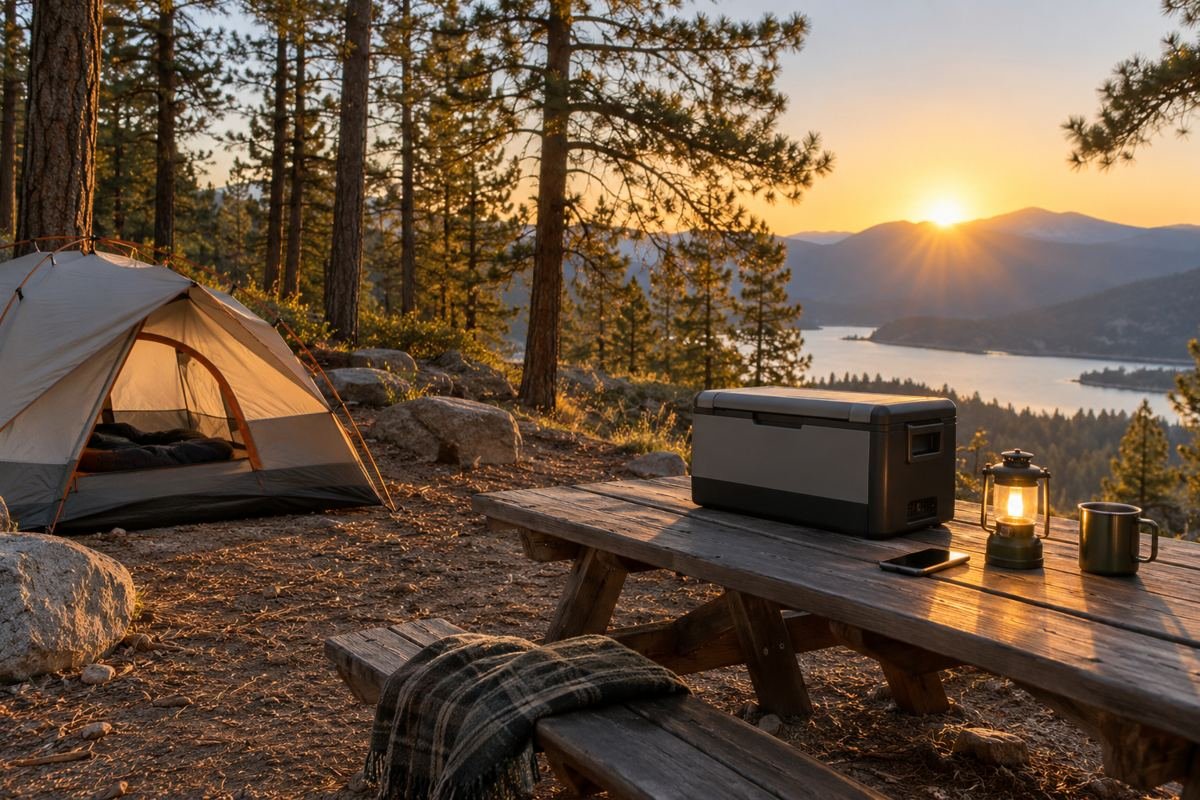
This Jackery Explorer 1000 v2 review examines whether this 1,070Wh portable power station is worth buying for camping. We’ll look at battery capacity, charging performance, estimated runtime, and its advantages and limitations to help you decide whether it’s the right choice for your camping needs.
This is a research-based review of the US model, checked against Jackery’s published information on October 25, 2026. We have not hands-on tested this unit; runtime examples below are calculations, not measured results.
Jackery Explorer 1000 v2 Review: Is It Good for Camping?
The Explorer 1000 v2 is worth considering if you want a single portable battery for modest campsite loads and can recharge between trips. Its strongest use case is keeping everyday essentials running, rather than replacing campground hookups. If you expect your energy needs to grow, compare expandable systems before buying.
The specifications that matter
| Specification | US Explorer 1000 v2 |
| Battery capacity | 1,070Wh |
| Battery chemistry | LiFePO₄ |
| AC output | 1,500W total continuous; 3,000W instantaneous rating |
| Weight | About 23.8lb / 10.8kg |
| AC outlets | Three, sharing the total AC output limit |
| USB charging | USB-C up to 100W and 30W; USB-A up to 18W |
| Solar input | Up to 400W total across two inputs; electrical limits apply |
These figures come from Jackery’s US product and support pages. The surge rating is not a continuous operating allowance: a device’s starting requirements still need to be compatible.
What makes it useful at a campsite?
Portability matters when the battery lives in your car between trips. Around 24lb is still a noticeable carry, but it is a manageable size for many people moving power a short distance to a campsite. It is less appealing if you need to carry all your equipment on foot.
The mix of AC, USB and vehicle-style outputs lets you choose a connection that suits the device. For compatible electronics, direct USB charging avoids running a separate AC charger. Check the voltage and connector requirements for a camping fridge rather than assuming any outlet will work.
How long will it run your equipment?
Start with energy use rather than a headline number of hours. A fridge that averages 20W over a whole day uses 480Wh; one averaging 40W uses 960Wh. That difference can determine whether one charge covers your trip.
The following planning examples assume 800Wh reaches the load. This is a deliberately stated calculation assumption, not a verified usable-capacity measurement. It leaves an allowance below the 1,070Wh nameplate rating; actual results depend on output type, standby draw, temperature and appliance behavior.
| Example average draw | Calculated runtime using 800Wh |
| 20W | 40 hours |
| 40W | 20 hours |
| 60W | About 13 hours |
| 100W | 8 hours |
| 500W | About 1.6 hours |
For cycling appliances, use their average consumption over time, not just compressor running watts. Inverter standby consumption is especially important at light AC loads, so these simplified figures may be optimistic. Subtract other devices’ energy use and keep a reserve. Our portable power buying guide explains watts and watt-hours.
Charging: plan around your actual power source
Jackery advertises roughly one-hour emergency charging, while its support table lists about 1.7 hours for AC charging. Treat the shorter time as mode-dependent rather than a promise for every recharge. Its published pages differ on app activation details, so confirm the instructions for your unit and firmware.
Solar can extend a stay, but the 400W maximum is an input ceiling, not guaranteed panel production. Shade, cloud, panel angle and temperature all affect harvest. Check Jackery’s connection rules: the two inputs do not mean you can freely combine different panel configurations.
A slow vehicle recharge can also change the practical value of the system. Before a road trip, confirm the charging method, cable and expected recharge time rather than relying on a short drive to refill the battery.
Pros
Useful capacity for moderate loads; portable enough for vehicle-based camping; a range of output connections; and solar charging for trips where compatible panels and good sunlight are available.
Cons
The battery cannot be expanded with add-on packs. It is not waterproof or dustproof, so campsite protection matters. High-draw appliances can consume the stored energy quickly, and total trip cost rises when panels or accessories are needed.
Price and warranty: check the complete package
Jackery’s US page showed $499 for the black standalone unit when checked on October 25, 2026. Promotions and bundles change, so check the selected variant and checkout price. Compare the total for the battery, panels and required cables—not just the discounted headline.
Jackery describes a three-year standard warranty with a two-year extension available. Check the seller’s eligibility, extension requirements and current warranty terms rather than assuming every purchase automatically receives five years.
Who should buy it?
Consider it for car camping, modest RV accessory loads or short backup needs when you have calculated your consumption and have a workable recharge plan. Choose a smaller battery if you mainly charge phones. Look at larger or expandable capacity if you need several days without charging, or sustained high-power equipment.
Final verdict
The Explorer 1000 v2 makes sense when portability and a realistic energy budget align. Buy it because it covers your measured needs at a competitive total price—not because the output rating sounds like unlimited runtime. For camping, a careful load plan is more valuable than an optimistic hours claim.
Sources and review method
Specifications and manufacturer claims were checked against Jackery’s US Explorer 1000 v2 product page and its technical support table. Opinions are our interpretation of those specifications; runtime calculations use the assumptions stated above. Learn more about our editorial approach.
Pingback: Jackery Explorer 1000 v2 vs EcoFlow DELTA 2: Which Is Better for Camping? - Portable Power Expert
Pingback: LiFePO4 vs Lithium-Ion Portable Power Stations: What's the Difference? - Portable Power Expert
Pingback: What Size Portable Power Station Do I Need for Camping? (Watt-Hour Guide) - Portable Power Expert