
We may earn money or products from the companies mentioned in this post.
Anker SOLIX C1000 Gen 2 review: Anker’s upgraded 1,024Wh portable power station brings a substantial 2,000W AC output, exceptionally fast advertised mains charging and a compact 24.9lb design. For US campers and households wanting backup power for individual appliances, it deserves a place on the shortlist. But there is an important catch: this generation’s battery is not expandable, and a 1kWh unit will not run high-draw equipment for long.
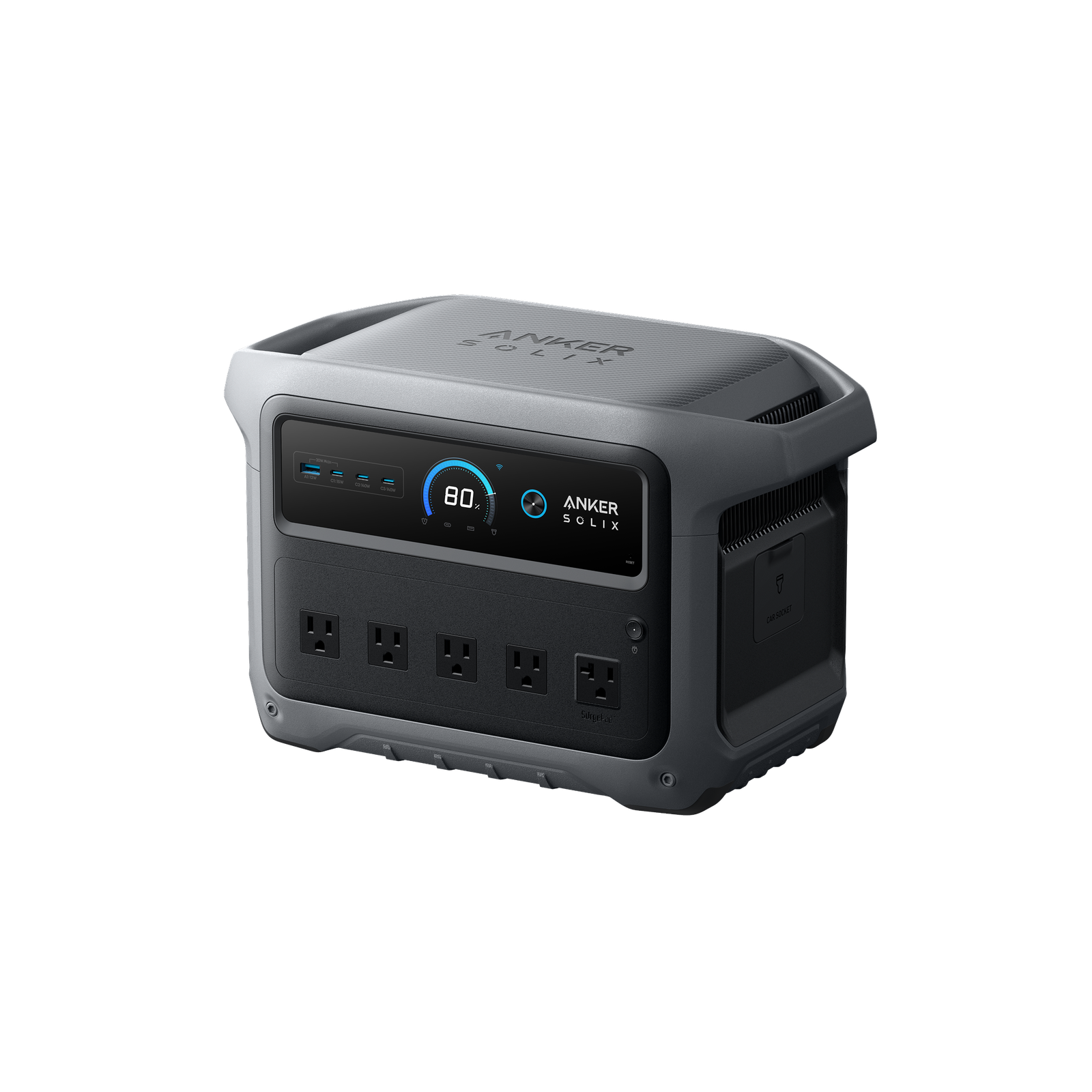
Anker SOLIX C1000 Gen 2 review: key specifications
The figures below describe the US 120V model, using Anker’s US product information and manufacturer documentation.
| Feature | Specification |
|---|---|
| Battery storage | 1,024Wh; LFP (LiFePO4) |
| AC output | 2,000W continuous, 3,000W advertised surge |
| Output voltage | 120V US model |
| Fast AC charging | Up to 1,600W in UltraFast mode; claimed full charge in 49 minutes |
| Normal AC charging | Up to 1,200W |
| Solar input | 600W maximum; panel voltage and current limits apply |
| Ports | Ten output ports including AC, USB-A, USB-C and 12V car socket |
| USB-C | Two up-to-140W USB-C outputs, plus a lower-power USB-C port |
| Battery cycle claim | At least 80% capacity after 4,000 cycles (manufacturer claim) |
| Weight | 24.9lb (11.3kg) |
| Size | 15.12 × 8.19 × 9.61 inches |
| Transfer time | 10ms UPS switching claim |
| Expandability | No external expansion-battery support |
| Warranty | Five years, subject to terms |
What can the C1000 Gen 2 run?
The headline advantage is 2,000W continuous AC output from a battery roughly the same size as many competitors’ 1,800W models. This lets it operate a surprisingly broad selection of appliances, provided the combined running wattage stays within the limit and starting surges are supported.
But output watts and battery watt-hours are different. The 2,000W figure tells you how much equipment it can power at once; the 1,024Wh figure tells you approximately how long. After inverter losses, an illustrative 850Wh AC-energy budget gives:
| Typical steady load | Illustrative operating time |
|---|---|
| 60W laptop setup | About 14 hours |
| 100W television | About 8.5 hours |
| 300W equipment | About 2.8 hours |
| 1,000W appliance | About 50 minutes |
These are planning examples, not guaranteed runtimes. Real power draw varies and battery management consumes some energy. A refrigerator’s compressor cycles on and off and requires a startup surge. Our refrigerator backup guide explains the difference.
Unsure what your appliances need? Use our free power station calculator before buying.
How fast does the Anker SOLIX C1000 Gen 2 charge?
Anker advertises a remarkable 49-minute full AC recharge using its 1,600W UltraFast mode, which must be enabled in the app. The standard AC input rating is lower, at up to 1,200W. Charging times vary with battery temperature, settings and supply conditions, and faster charging may involve greater fan noise.
For solar charging, the maximum input is 600W. That ceiling does not mean every panel will supply 600W: conditions, shading, panel orientation and electrical limits matter. Check the stated voltage ranges and current limits before connecting solar equipment. Anker also indicates solar and AC can be used together, with solar prioritised.
Our portable power station solar-charging guide explains wiring, input limits and realistic charging expectations.
Portability and longevity
At 24.9lb, the C1000 Gen 2 is reasonably manageable for a 1kWh-class battery, though it’s still something you will notice carrying over a long campsite walk. Anker claims the lithium iron phosphate battery retains at least 80% of its original capacity after 4,000 cycles. That is a cycle-life claim, not a guarantee of identical performance in every climate or usage pattern.
The manufacturer advertises UPS switching within 10ms. That may help protect some electronics from short power interruptions, but it is not a substitute for checking the requirements of sensitive or medical equipment.
Anker SOLIX C1000 Gen 2 pros and cons
What stands out
- High continuous 2,000W output for the 1,024Wh class.
- Exceptionally fast advertised AC charging if you use UltraFast mode.
- Useful high-wattage USB-C charging for laptop users.
- Compact design and reasonable weight.
- Useful app features and manufacturer-stated 5-year warranty.
What to consider
- The 1,024Wh battery can be drained quickly by heaters, kettles or other heavy loads.
- Unlike the previous C1000, Gen 2 does not support expansion batteries.
- 600W maximum solar input is lower than the 1,000W published for some competing models.
- Actual usable AC energy falls below rated storage due to conversion losses.
- Manufacturer fast-charge and UPS figures depend on conditions and device compatibility.
How does it compare with Jackery, EcoFlow and BLUETTI?
We’ve covered several alternatives in this popular battery-size category. Read our BLUETTI Elite 100 V2 review if solar input is your priority: BLUETTI advertises up to 1,000W of solar input and a 1,800W AC inverter. Our EcoFlow DELTA 3 review discusses another flexible camping and backup option, while the Jackery Explorer 1000 v2 review helps shoppers considering portability and straightforward operation.
Don’t choose purely on brand or headline wattage. Compare real purchase price, total output, delivered energy, weight, noise and the actual appliances you plan to run. For a wider shortlist, see our best portable power stations for camping guide.
Anker SOLIX C1000 Gen 2 review: final verdict
For camping, RVs and short-duration backup of selected essentials, the Anker SOLIX C1000 Gen 2 is worth considering. Its high output, strong USB-C selection, quick charging and manageable weight make it a practical contender. Its biggest limitation is simple: it offers only around 1kWh of storage and cannot be expanded, so don’t confuse powerful output with all-day backup for energy-hungry appliances.
Start by identifying the things you actually need to power and their running times. That will help you judge whether 1kWh is enough—or whether you should budget for a bigger system.
Explore the Anker SOLIX C1000 Gen 2 on Anker’s US website → (manufacturer link, not an affiliate offer).
Specifications reflect the US model and are subject to revision. Performance examples are estimates. Product references and manufacturer claims are linked for verification. See our affiliate disclosure.