
We may earn money or products from the companies mentioned in this post.
DJI Power 1000 V2 review: DJI is best known for drones and cameras, but its Power 1000 V2 is a serious contender in the portable battery market. With a 1,024Wh LiFePO4 battery, up to 2,600W continuous AC output and fast charging, it targets campers, mobile creators and people needing short-duration home backup. But high output doesn’t magically increase battery capacity: at heavy loads, a 1kWh station empties quickly.
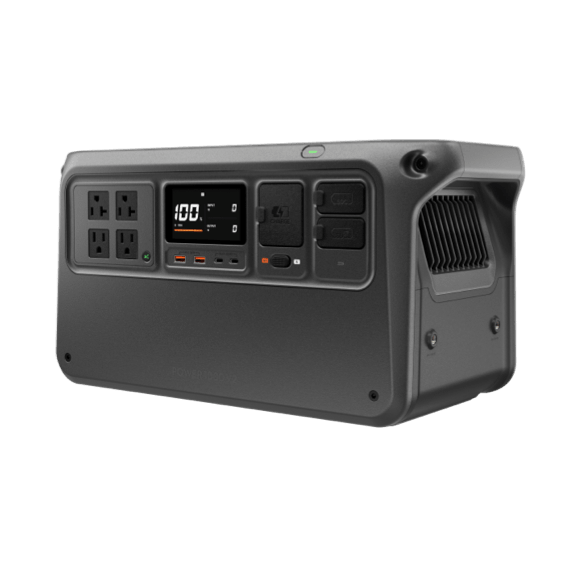
Interested in the DJI Power 1000 V2? Compare its specifications and see the current price on DJI’s official US store.
Official manufacturer link. Price and availability may change.
DJI Power 1000 V2 review: key specifications
| Feature | DJI Power 1000 V2 |
|---|---|
| Battery capacity | 1,024Wh LiFePO4 |
| Continuous AC power | 2,600W (manufacturer rating; US configuration) |
| Fast AC charging | 0–80% in about 37 minutes, full in around 56 minutes (claims) |
| USB-C | Two 140W USB-C outputs, 280W combined maximum |
| USB-A | Two ports |
| Other connections | SDC and SDC Lite connections for compatible accessories and DJI drone charging |
| Battery longevity | 80% remaining capacity after 4,000 cycles (manufacturer test claim) |
| Expansion | Can support compatible DJI expansion batteries; check model/accessories |
| Warranty | Up to five years according to DJI, subject to terms |
These figures are based on DJI’s official Power 1000 V2 product information and the product manual. Regional AC outlet formats and specifications differ, so US shoppers should verify the US configuration.
What can the DJI Power 1000 V2 run?
Its 2,600W continuous output is unusually high for the 1kWh class. That means it can power many appliances requiring significant instantaneous wattage, assuming compatibility and a manageable starting surge. Running time is the trade-off.
If you allow approximately 850Wh of usable AC energy after losses as an illustrative planning assumption, a 100W load could run for about 8.5 hours, a 500W load for about 1.7 hours and a 1,500W load for only about 34 minutes. Real runtimes vary depending on temperature, appliance cycling, inverter losses and how completely the battery can discharge. These are calculations, not measured results for this unit.
That makes the unit especially appealing for short bursts of higher-power use, charging laptops and cameras, or powering essential appliances temporarily. It’s less compelling as a stand-alone all-night solution for a high-draw heater. See our refrigerator runtime guide and use the free battery-size calculator to estimate your own needs.
DJI Power 1000 V2 charging, solar and drone advantages
DJI advertises 0–80% recharge in around 37 minutes and a full charge in around 56 minutes under its fast-charge conditions. Those speeds are useful when you can plug in before a trip or during a short campsite stop, although actual charging times depend on the wall supply, settings and temperature.
Solar charging is supported with compatible adapters and accessories. Before purchasing panels, check connector compatibility, maximum input and allowed panel voltage: solar panels aren’t automatically interchangeable between brands. Our solar-charging guide explains how to match a panel to a power station.
One distinction that sets DJI apart is support for rapid charging of compatible DJI drone batteries through its SDC connection and suitable accessories. For photographers and drone operators in the field, that may be more useful than a small difference in AC wattage.
Battery longevity, portability and home backup
DJI describes its LFP battery as retaining 80% capacity after 4,000 cycles in specified testing conditions. That is a long cycle-life claim, not a guarantee of ten calendar years under all storage temperatures or use patterns.
DJI promotes relatively quiet charging and a variety of output ports. Noise depends on operating mode and cooling demand; any advertised minimum figure should not be interpreted as a guarantee when charging fast or supplying heavy loads.
For home use, it can support selected appliances, but do not confuse a portable station with a whole-house backup installation. For critical equipment, verify power compatibility and any backup-switching requirements independently.
DJI Power 1000 V2 review: pros and cons
Advantages
- High 2,600W continuous output relative to battery capacity.
- Fast advertised recharge time.
- Useful dual 140W USB-C charging for modern laptops.
- Accessory ecosystem especially relevant to DJI drone owners.
- Optional compatible expansion batteries provide a route to more storage.
Limitations
- At 1,024Wh, high-power appliances can drain the battery quickly.
- Some charging and solar configurations require extra adapters.
- Price and accessory costs should be compared with competing brands.
- Manufacturer performance claims depend on test conditions.
- US and non-US versions can differ, so confirm the exact SKU before purchasing.
How does DJI compare with Anker, BLUETTI and EcoFlow?
DJI’s selling point is high output combined with fast charging and drone integration. The Anker SOLIX C1000 Gen 2 is another strong 1kWh-class contender with fast charging and 2,000W continuous output. Our BLUETTI Elite 100 V2 review covers its 1,800W continuous output and substantial stated solar-input capability. The EcoFlow DELTA 3 and Jackery Explorer 1000 v2 also deserve consideration, depending on weight, outlets, warranty and current pricing.
Rather than comparing only the biggest wattage figure, calculate how much energy you’ll use over a day, then compare real weight, delivered AC energy and purchase cost. For more buying ideas, see our camping power station guide.
Interested in the DJI Power 1000 V2? Compare its specifications and see the current price on DJI’s official US store.
Official manufacturer link. Price and availability may change.
DJI Power 1000 V2 review verdict: should you buy it?
It’s worth considering for campers, content creators and DJI drone owners who value fast charging and high-power output. The main caution is not to mistake a powerful inverter for a large battery. If you routinely need many hours of backup, compare larger-capacity alternatives or the cost of compatible expansion options.
See DJI Power 1000 V2 specifications at DJI → (manufacturer information, not an affiliate link).
Specifications are attributed to the manufacturer, may change and should be confirmed for the exact US unit. Runtime illustrations are estimates. See our affiliate disclosure.