
We may earn money or products from the companies mentioned in this post.
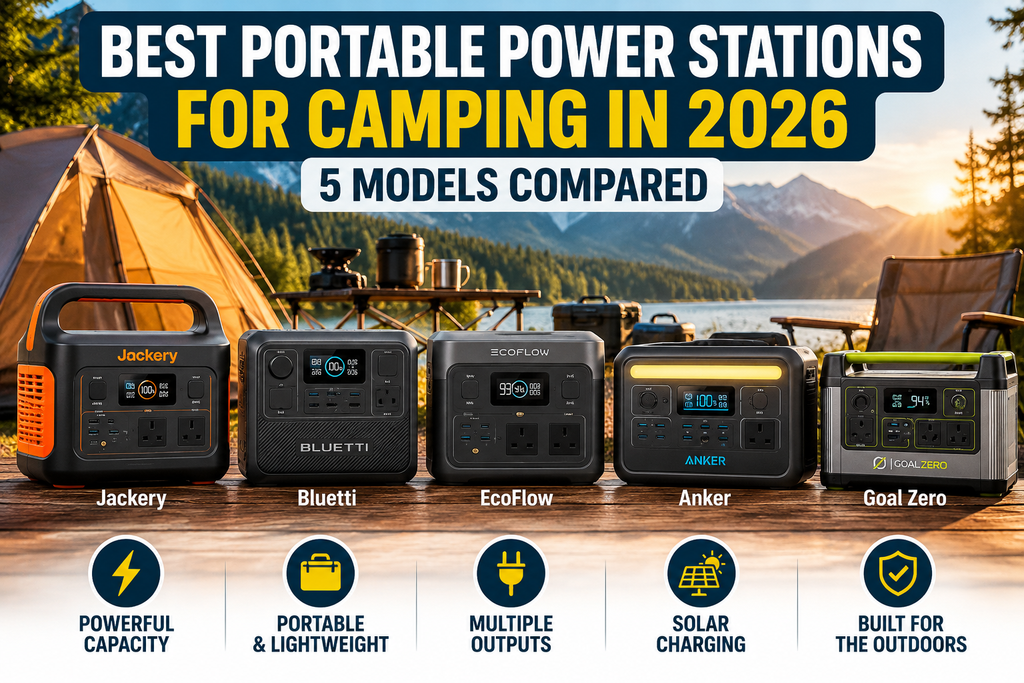
Looking for the best portable power stations for camping in 2026? The right choice depends on what you need to run, how long you stay off-grid and whether you can recharge from a car, mains socket or solar panel. This guide compares five well-known options and explains how to choose without paying for more capacity than you need.
Editorial note: This is a research-based buying guide, not a hands-on test. Model specifications, regional versions, availability and prices can change. Check the manufacturer’s current product page before buying. We have not included affiliate links yet.
On this page
Best portable power stations for camping: five models compared
| Power station | Who should consider it | Key buying consideration |
|---|---|---|
| Jackery Explorer 1000 v2 | General weekend camping | Balance of capacity, output and portability |
| EcoFlow DELTA 2 | Campers who value flexible charging | Compare current pricing and expansion options |
| Anker SOLIX C1000 | Buyers comparing 1kWh-class stations | Check size, weight and output for your appliances |
| BLUETTI AC180 | Campers needing more appliance headroom | Confirm sustained and surge output |
| EcoFlow RIVER 2 Pro | Smaller setups and lighter loads | Lower capacity may mean shorter runtime |
1. Jackery Explorer 1000 v2 — a strong all-round option to compare
The Explorer 1000 v2 is a sensible starting point if your camping setup includes a fridge, lights, phones and occasional laptop charging. Before buying, calculate your expected daily energy use and confirm that the station’s AC output can handle appliances that may start at a higher wattage than they normally consume.
Our Jackery Explorer 1000 v2 review covers the practical strengths, limitations and buying considerations in more detail.
2. EcoFlow DELTA 2 — worth comparing for charging flexibility
The EcoFlow DELTA 2 is among the best portable power stations for camping to compare if flexible recharging matters. It is another option in the roughly 1kWh class. Consider it if you expect to recharge between trips or want to explore compatible solar equipment. Pay close attention to the exact product version, input limits and what accessories are included in the advertised price.
See our Jackery Explorer 1000 v2 vs EcoFlow DELTA 2 comparison for a closer look at the trade-offs.
3. Anker SOLIX C1000 — another 1kWh-class contender
When comparing the SOLIX C1000 with Jackery and EcoFlow models, look beyond advertised charging speed. Check the unit’s weight, socket layout, warranty terms, solar-input compatibility and whether the AC output is appropriate for the appliances you plan to run. This can be an attractive shortlist candidate, but the best value depends on current prices and your usage.
4. BLUETTI AC180 — consider it for appliance-heavy trips
If you want to run multiple devices or an appliance with a significant startup surge, compare the AC180’s continuous and surge ratings with your requirements. Capacity alone does not determine whether a station can power a particular device. The station’s size and weight also matter if you frequently move camp.
5. EcoFlow RIVER 2 Pro — consider a smaller-capacity setup
For phones, lighting, camera batteries and some laptop use, a smaller power station may be more practical than carrying a larger model. The trade-off is less stored energy and potentially less suitable AC output for power-hungry appliances. Estimate runtime before assuming a compact station can support an electric cooler or other continuous load overnight.
How to choose the best portable power stations for camping
Battery capacity: understand watt-hours
Battery capacity is usually measured in watt-hours (Wh). As a rough starting point, a 50W device running for five hours uses 250Wh. Real-world runtime will be lower than a simple capacity calculation suggests because of inverter losses, temperature, standby use and appliance cycling. Use our camping power station sizing guide to calculate your needs.
Output power: check watts and startup surges
Watts (W) describe how much power the station can deliver at once. Your total simultaneous appliance load must be within the rated output, and motor-driven appliances may briefly demand more power when starting. Verify the exact appliance requirements rather than relying on generic averages.
Solar charging: compatibility matters
Solar panels can extend a trip, but charging depends on sunlight, shading, panel angle, input limits and connector compatibility. Our solar charging guide explains the key checks.
Battery chemistry and cycle life
Many newer stations use LiFePO4 (LFP) batteries. Compare the actual manufacturer’s cycle-life and warranty claims rather than assuming every LFP battery performs identically. Learn more in our LiFePO4 vs lithium-ion guide.
For up-to-date specifications, check the official Jackery, EcoFlow, Anker and BLUETTI websites. Confirm the exact model and regional version before purchasing.
Which one would we choose?
When comparing the best portable power stations for camping, match capacity and output to your own devices. For a typical weekend campsite with several devices, start by comparing the Jackery Explorer 1000 v2, EcoFlow DELTA 2 and Anker SOLIX C1000. If your appliances have higher startup demands, include the BLUETTI AC180 in your comparison. For a lighter setup with fewer devices, check whether the EcoFlow RIVER 2 Pro offers enough usable capacity. There is no universal winner: choose based on your actual watt-hours, peak output needs, weight tolerance and the price available when you buy.
Frequently asked questions
How many watt-hours do I need for a weekend camping trip?
Add up each device’s average watts multiplied by hours of use, then allow for conversion losses and a reserve. A camping fridge can be especially variable because its compressor cycles on and off.
Can I use a portable power station inside a tent?
Follow the manufacturer’s instructions on ventilation, moisture, operating temperature and safe placement. Keep the station dry, avoid obstructing cooling vents and never use a fuel-powered generator inside a tent.
Do I need solar panels?
Not necessarily. If you can charge before departure and your battery has enough capacity for the trip, solar may be optional. It becomes more useful for longer stays away from mains power.
Bottom line: Start with the devices you need to run, not the biggest battery or boldest marketing claim. Then compare the shortlisted models against those requirements.